Ten Years of Tilt West: Reflecting on its Origins, Mission, and What Comes Next
Ilan Gutin in conversation with artist Sarah McKenzie around Tilt West’s 10th anniversary season theme of CHANGE, reflecting on co-founding Tilt West, fostering critical dialogue, and making space for what comes next.
Interview with Sarah McKenzie
Ilan: Hi, Sarah. It’s great to speak with you today, thanks for being here. To start us off, would you mind introducing yourself and sharing a bit about your background?
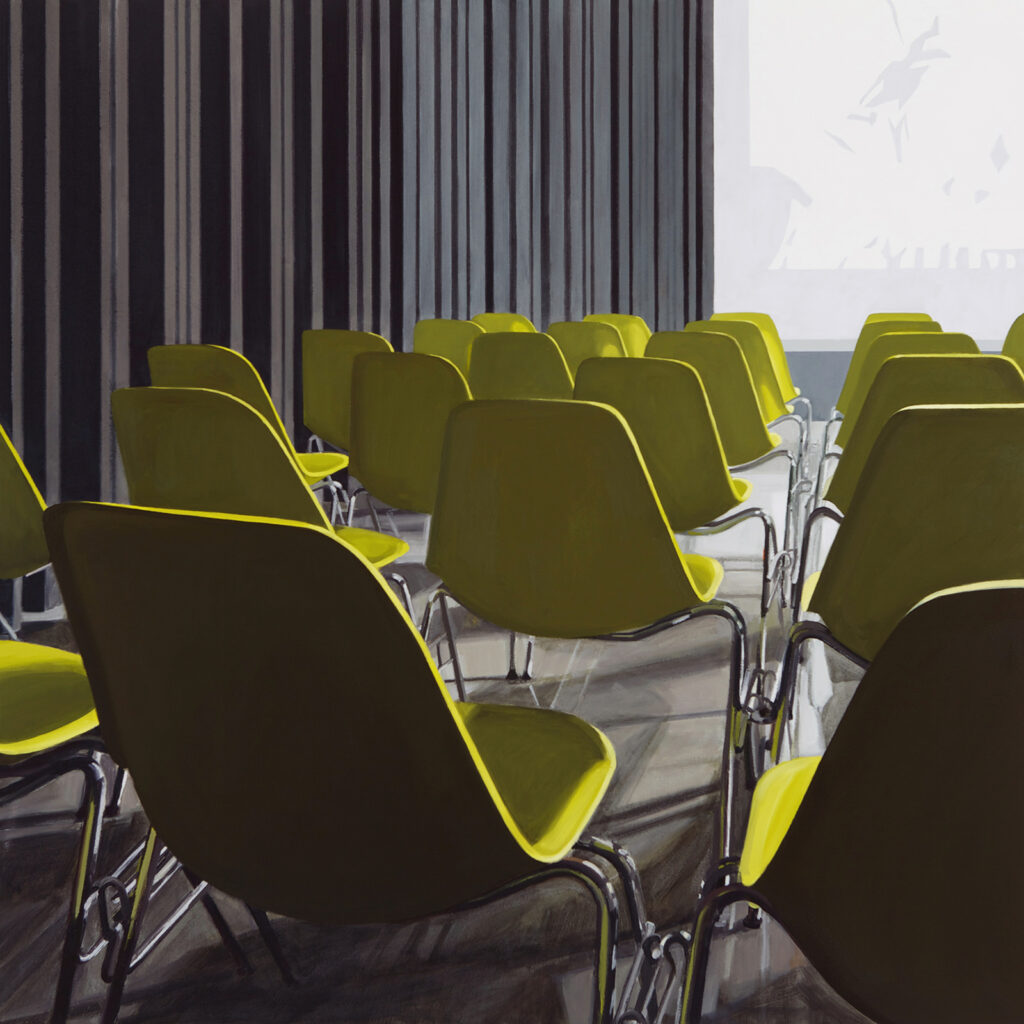
Sarah: Sure. Thank you, Ilan. I’m Sarah McKenzie and I’m a painter. I’ve lived in Colorado since 2006 and I live in Boulder. I show with David B. Smith Gallery in Denver. I make paintings about architecture and the built environment. I’m also one of the co-founders of Tilt West. Along with Sarah Wambold and Whitney Carter, the three of us conceived of Tilt West back in 2015, then assembled a board and formally started the organization in the fall of 2016.
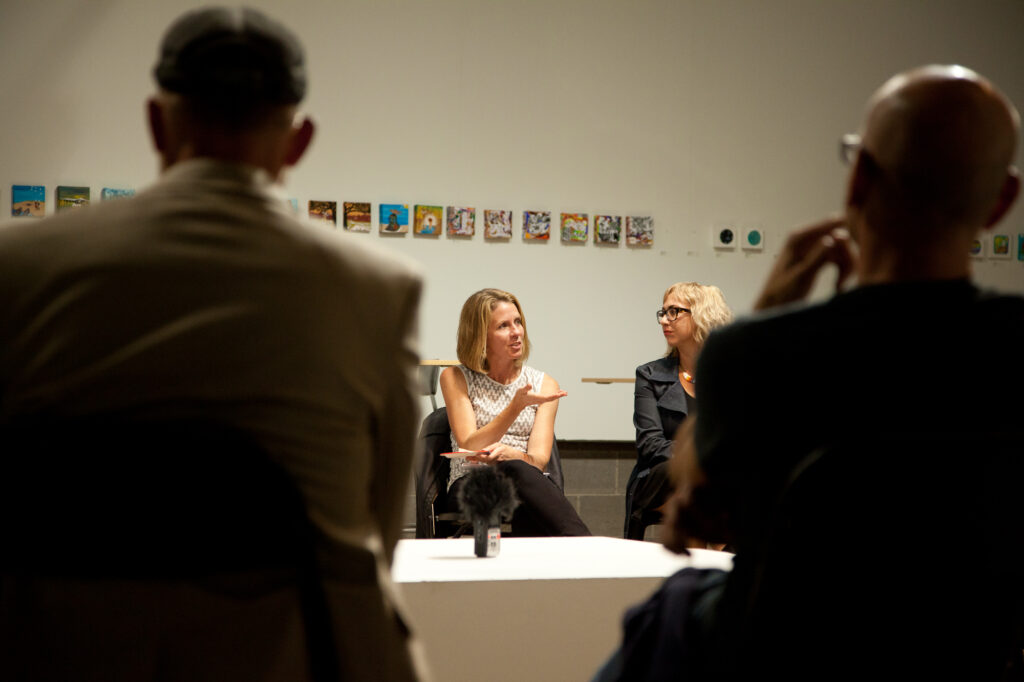
Ilan: Speaking of Tilt West, the organization is in its 10th season with the theme of “Change”. When you look back ten years ago, when you and Sarah and Whitney founded Tilt West, what kind of change were you hoping to spark in Denver’s creative arts community?
Sarah: At that time, both Whitney and Sarah had recently relocated to Denver. Whitney had been running a gallery in Los Angeles and moved to Denver to be closer to family, and she was working with David B. Smith at his gallery. Sarah Wambold had moved from Chicago, where she’d been working with the Art Institute of Chicago.
In our early conversations, we were thinking about how Denver hadn’t yet achieved the same ambition as art scenes in cities like Chicago and Los Angeles. There were, and still are, many really interesting artists working in this region, and galleries doing strong programming, but the overall level of discourse around the arts in Denver at that time felt a bit parochial or regional. Not as critical, in the best sense of that word.
We wanted to see a more sophisticated level of conversation around arts and culture. The initial impetus was asking ourselves: What could we create that would help drive the conversation in Denver to feel more national or international in scope, and help turn up the volume on the great work that was already happening here?
![Sarah McKenzie (3rd from the left) with fellow curators and artists at Redline [2025]](http://tiltwest.org/wp-content/uploads/2026/01/with_fellow_curators_and-artists_at_Redline_2025-1024x695.jpg)
Sarah: Our first idea was actually to create a publication. At the time, DARIA [Denver Art Review, Inquiry, and Analysis] didn’t yet exist. There were art reviews in Westword and the Denver Post, but those were written for a general audience. We didn’t feel there was much arts writing in Denver that was specifically targeted to the arts community or to people with a more nuanced understanding of contemporary art.
We imagined creating something that might fill that gap, but none of us felt equipped to immediately start a publication. That wasn’t part of our professional backgrounds. I had a former colleague who had started an organization in New York called Critical Practices, Inc., which hosted roundtable conversations, very much in the style of how we now run events at Tilt West.
We thought that could be a good starting point. Maybe we’d pursue a publication later, but for now we could host events, get our name out there, and have rich conversations about the arts and see what developed. Critical Practices, Inc. agreed to let us adapt their model, and fall of 2016 became our first roundtable season.
As for becoming a nonprofit, we always assumed there wouldn’t be a way to charge admission or operate as a for-profit organization, but we knew we’d need funding. Becoming a nonprofit just felt like a no-brainer from the start.
Ilan:
I had no idea the Tilt West roundtables were modeled after another organization.
Sarah: Yes, our “rules of the game” document is adapted from Critical Practices, Inc. They were the ones who chose that language for the guidelines. I think they even used the French term les règles du jeu, being in New York, they were very highbrow.
![Sarah McKenzie moderating artist panel at East Window Gallery with incarcerated artists [2025]](http://tiltwest.org/wp-content/uploads/2026/01/moderating_artist_panel_at_East_Window_Gallery_2025-1024x796.jpg)
Sarah: Yes. It was pretty wild. I think we were all confident that Hillary Clinton was about to become the first woman president, so it didn’t feel risky to schedule an event for that evening. Then we were all in shock, but we decided to go ahead with it because it felt like a night when people really wanted to come together and process what might be happening in our country.
We had the scheduled conversation, but there was also acknowledgment of the historical moment we were in.
Ilan: That must have been an intense night.
Sarah: Cortney Lane Stell was the first prompter for that roundtable. And even though it was nearly ten years ago, I remember her doing a wonderful job of holding space for people to process what they were feeling, while still helping keep the conversation on track.
Ilan: In those early days, did you have a sense of what Tilt West might become, or has its evolution surprised you?
Sarah: In some ways, it became exactly what we envisioned. We knew early on that we wanted to pursue a publication, and we did eventually produce a journal for three about years before shifting directions.
But we never got overly hung up on long-range planning. We had loosely defined goals, but everyone was volunteering their time, and none of us really knew exactly what we were doing. We figured things out as we went along. There was a strong commitment from the board from the beginning, paired with a sense of realism, none of us were being paid, and we didn’t know yet if the Denver art world or funders would support what we were doing.
That flexibility was a good thing. We never held ourselves to rigid five- or ten-year plans. We were fairly easy on ourselves about meeting goals.
Ilan: After ten years, why does now feel like the right time for you to step away?
Sarah: I’m the only one of the three original founders still involved. Whitney Carter and Sarah Wambold stepped away a few years ago to pursue career changes. Kate Nicholson and I are the only original board members remaining.
There were years when I was doing a lot of the organization’s day-to-day work, and I think there’s a recognition that if an organization is going to last, it has to be bigger than one person. Sometimes founders play an outsized role early on, and that can eventually prevent an organization from growing or changing in the ways it needs to.
At this point, there’s an incredible board in place. It feels like the right moment to step back, trust others to carry the torch, and help ensure Tilt West’s long-term sustainability.
I’ve also become deeply involved in other work, including teaching art inside prisons. That’s where I feel most needed right now, and I know Tilt West no longer needs me in the same way.
![Sarah McKenzie teaching at Sterling Correctional Facility [2025]](http://tiltwest.org/wp-content/uploads/2026/01/teaching_at_SterlingCF_2025-1024x683.jpg)
Sarah: In my studio practice, I tend to work in five to seven year cycles. Eventually, I reach a point where I’ve solved the problems the work raised for me. I could keep going, but I’m no longer learning anything new. That’s usually the moment when it’s important to shift gears and try something uncomfortable.
I see a parallel with professional responsibilities like serving on a board. Tilt West has the potential to become something new in its next decade, and that’s more likely if those of us who were leading in the first ten years make space for new people. Tilt West belongs to the arts community; it's bigger than any one person. That’s what gives it the best chance to last.
Ilan: So you see it as something fluid, with a life of its own.
Sarah: Yes. I hadn’t thought about it that way until recently. There were times when I probably resisted changes that felt too far from the original mission. But now I think that’s okay. If the board moves in a new direction, that’s exciting! That’s the evolution of the work.
Ilan: You’ve mentioned your current work with artists in the prison system. Can you talk about how you became involved and why it resonates with you?
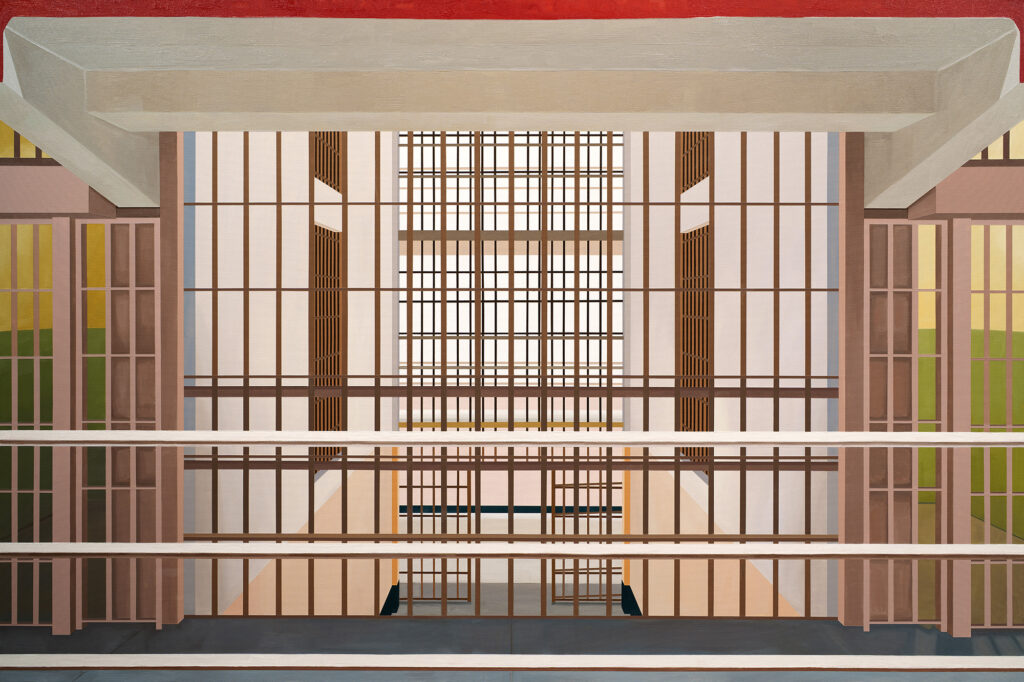
Sarah: I originally became involved because I wanted to make paintings about the architecture of prisons. It started as an intellectual curiosity. When I started researching prisons, many people I interviewed emphasized that if I wanted to make work about carceral spaces, I needed to understand the people impacted by them.
During COVID, I reached out to the University of Denver Prison Arts Initiative (DUPAI) to volunteer. I didn’t expect to teach, but that opportunity came quickly. I wound up teaching drawing in the Colorado Department of Corrections (CDOC) through DUPAI for two years. DUPAI stopped working inside the CDOC in 2023. I was desperate to get back inside to continue teaching, so in 2024 I co-founded the nonprofit Impact Arts with Lilly Stannard.
After decades in the art world, it can be easy to feel cynical about how art functions as a luxury commodity. Teaching inside prisons reminds me of the deeper value of creative practice, how it can restore agency, build community, and give people a reason to get up every morning. That work has re-centered me in why I make art at all.
Ilan: I think that really speaks to the power of art, how it can have such a profound effect on people who are incarcerated.
Sarah: Yes, definitely.
Ilan: And like you said, it gives them a reason to get up, to feel motivated, and to accomplish something they have control over in a world where they don’t have much control.
Sarah: Yeah, right. It also really builds community. I teach at Sterling Correctional Facility, and there are men who are sort of “art friends” who probably wouldn’t talk to each other if not for the fact that they’re both artists. Our prisons are very racially segregated, so it’s meaningful to see how art can transcend that and become a kind of glue that allows people to connect across differences.
Ilan: Is it complicated for you to move between those spaces, working with incarcerated artists and then returning to the commercial art world, like attending an opening at David B. Smith or another gallery? What does that feel like?
Sarah: I wouldn’t say it’s really hard. Through my curatorial work over the past few years, I’ve been trying to bridge those two worlds, creating opportunities for artists in the prison system to have their work seen in contemporary art spaces, and maybe to challenge the contemporary art world a bit.
I’m not the only person doing this. Curators around the country have led the way, and if anything, I’m late to the conversation. I don’t give myself much credit for the idea itself. But I do think there’s a growing recognition that the contemporary art world should be open to the stories and perspectives that artists in the system can share. It’s not enough to say, “That’s outsider art, that’s something over there.” I’m trying, at least in our region, to suggest that this work is actually related to the same questions many of us are already thinking about.
I will say that I’ve become impatient with exhibitions that are only about good-looking objects. I don’t want to dismiss beauty or suggest the work lacks depth, but because of this prison work, I’ve come to value art that asks me to think about something beyond, “Wow, that’s beautiful.” When I go to galleries or museums now, I find myself placing more value on work that challenges us to think about society in deeper ways.
Ilan: I think that comes through in your own work. Your paintings are beautiful, but they don’t glamorize the prisons you depict. They feel very frank and stark, and they’ve made me think about things like the lack of windows and what it might feel like to exist in those spaces.
Sarah: Thank you! That’s my hope.
Ilan: What parallels do you see between the conversations Tilt West has fostered and the conversations you’re facilitating through prison arts programming?
Sarah: Going back to the fact that our first roundtable happened the day after the 2016 election, I think there’s a lot we didn’t anticipate when we were imagining Tilt West in 2015 and early 2016. We expected a certain level of intellectual conversation around arts and culture, but we didn’t anticipate how central politics, activism, race, cultural identity, access, and representation would become to our programming. We’ve gone through so much political and social upheaval over the past ten years, and all of that has filtered into Tilt West’s roundtables. We’ve tried to reflect what our community has grappling with. Whether it was roundtables on AI or NFTs, we paid attention to what was rising to the surface in the broader arts discourse and made sure our conversations addressed those topics.
Tilt West has become much more socially and politically engaged than we initially imagined, and I think I have as well. That engagement led directly to my interest in prisons and to reorganizing my creative career around working with incarcerated artists. It’s all interconnected; Tilt West’s evolution paralleled my own, and that changed me as an artist.
Ilan: I’d love to talk a bit about your own art practice. How would you describe the themes and core questions you’re pursuing right now?
Sarah: That’s an interesting question because I’m very much in a transitional year. As I mentioned before, most of my projects have a five- to seven-year arc. Before the prison work, I was making paintings about exhibition spaces and museums, thinking about institutional architecture and how it communicates social codes and cultural values.
That led me to prisons, which are also institutional spaces designed to communicate authority and state power. This past spring, I had a solo exhibition at David B. Smith Gallery that showed several of my prison paintings alongside new museum paintings, exploring the parallels between those spaces. Museums and prisons may seem very different, but they’re more similar and connected than we might imagine.
Now I’m thinking about what comes next. Over the summer, I participated in a group exhibition in Bucharest, Romania, my first time in an Eastern European city that was part of the former Soviet bloc. Seeing architecture from the Ceaușescu regime made me think about how buildings communicate state power or the authority of individuals in power. Pair that with what’s happening now, like Trump tearing down part of the White House to build a ballroom, and I’m still very interested in institutional space and power, but possibly beyond prisons and museums.
I have a residency in January where I’m planning to experiment, maybe even return to drawing. Ask me again in a year, and I’ll have a better elevator pitch for the new work.
Ilan: Looking back at Tilt West and the community you helped build, what feels most meaningful to you?
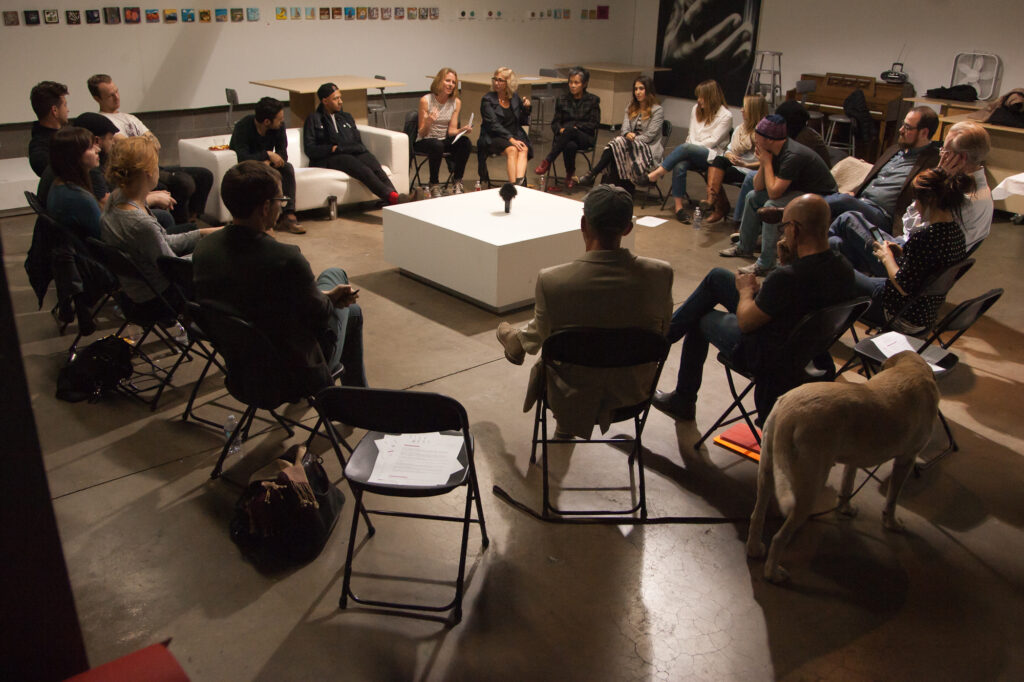
Sarah: One thing is the simple power of bringing people together in a room. Over the past decade, more and more of our interactions have moved online: Zoom meetings, social media, text. We spend less time talking face-to-face, even in our personal lives.
There’s something powerful about bringing thirty people, often strangers, into a room for ninety minutes, without screens, to focus on a shared conversation. That’s really our secret sauce. We didn’t invent it, Critical Practices, Inc. did, but it’s rare in Denver, and that’s why people keep coming back.
I was reminded of this when my new nonprofit, Impact Arts, hosted a roundtable for people volunteering inside prisons. None of the participants, except me, had ever attended a Tilt West roundtable. By the end, everyone said, “We need to do this more.” It reinforced how essential these conversations are, regardless of topic.
Ilan: Even when the topic isn’t something I know much about, I still find the roundtables valuable.
Sarah: Exactly. For people in academia, that experience of sitting in a room and discussing a shared topic is familiar. But once you leave school, it disappears from daily life. The roundtables bring that back. You don’t need to be enrolled in a class to experience the value of collective thinking.
Ilan: Do you hope the same thing happens with Tilt West’s publications?
Sarah: In some ways, yes, but it’s different. We originally wanted to elevate discourse through publishing. Now that publications like DARIA exist and do that work beautifully, we’ve had to rethink our role.
Our print journals were modeled after the roundtable structure: a shared theme with many contributors responding through different formats, poetry, essays, visual art, even music. The issue was that the labor involved in producing each volume far outweighed the readership we reached.
Now the website functions as our publishing platform, and the relationship between curated content and our roundtable events is still being figured out. That’s something I leave to the current board. We’re in a transition period, still shaping what this next phase looks like.
Ilan: What do you hope Tilt West continues to be over the next ten years?
Sarah: I hope the roundtables always remain at the heart of the organization. They’re what Tilt West is known for, and I don’t think any other group in Denver is offering something quite like them.
I also hope Tilt West continues to bridge different creative communities– visual arts, theater, dance, spoken word– that don’t always feel connected. At its best, Tilt West acts as a kind of glue, creating space for dialogue across disciplines.
Ilan: Is there anything else you’d like to add before we wrap up?
Sarah: I’m curious to see how Tilt West navigates technology in the future. We’ve historically kept events very low-tech, resisting streaming or heavy digital mediation. As younger board members step in, new perspectives will shape the next decade. I’m excited to step back and watch where it goes.