Making "Potemkin village"
Edited by кir alshanetsky
“ignore all possible concepts and possibilities […]
just make it, babe, make it”
– Charles Bukowski, “making it”
I want to take this opportunity to say something about the state of the/my world(s). More specifically, I want to name a feeling because identifying a feeling offers relational possibilities. This is what I aim to do through dance: trace the point where private feeling meets "the state of the world," a phrase that easily compartmentalizes lived experience. It can be easier to be told how you feel than it is to name your feeling for yourself. I am trying to be rigorous about feelings.
Here is an orientation point:

I am not going to pretend like the images in this meme template hold obvious similarities. The image on the left is of Kijǒng-dong, a Potemkin village on North Korea’s half of the DMZ. The image on the right is a screenshot of my Instagram feed. Both images demonstrate how public-facing façades present a coherent surface while concealing the conditions that produce it. Both also reveal something about how I negotiate and perform identity.
A "Potemkin village" refers to a façade erected to conceal an undesirable reality, creating the illusion that things are better than they are [2]. The term comes from Grigory Potemkin, who was mythologized as constructing false villages to impress Empress Catherine the Great during her tour of Crimea in 1787. Whether historically accurate or not, the story persists because it captures a familiar logic: spectacle can stand in for reality.
Here, the mythology of romance becomes its own Potemkin village; he loved her so much that he emulated whole false towns to create the illusion that colonization efforts in the Ukraine had progressed further than they had.
The term has since grown to describe any façade that manages perception rather than reality. A spin on a story. A cover-up. The point is not simply to hide what exists, but to direct attention elsewhere—to make you feel you are not receiving the whole story, because you are not.
The dance I am making is about the façades we construct and maintain to survive, and the selves that remain hidden behind them. It asks what happens when those structures collapse, when the version of ourselves built for public consumption can no longer hold, and we are forced to negotiate the world, and one another, from a place of attention and presence.
What interests me is less the existence of these façades than the feeling they produce: contradiction, paralysis, uncertainty about how to move through the world at all. I am making this dance from within that condition. I am not claiming that dance is direct action. I do, however, believe that dance creates a space where ideas can be worked through in the body, where movement and the shared experience of embodiment become ways of communicating desire for connection, for dissent, for a different kind of world.
On Instagram, I become a version of myself optimized for circulation. I post rehearsal footage, travel photos, grant announcements, upcoming performances, evidence of a life in motion. As a trans person, there is a potential sense of self-determination in choosing the images through which I am seen. And yet, the feed remains a Potemkin village: a carefully maintained exterior that tells a coherent story while obscuring the uncertainty, boredom, grief, and labor that make that story possible.
I know this façade is incomplete, and I maintain it anyway. The post that convinces you I am thriving also conceals my ambivalence about participating in a platform that extracts attention for profit. It conceals, too, the contradictions of moving through a world shaped by surveillance and ongoing violence toward QTPOC communities. In the same feed I can scroll past a polished portrait of a trans, Jewish celebrity and another post calling attention to that celebrity's continued inaction in the face of Zionist propaganda.
I do not bring up this celebrity to neatly compartmentalize blame in one individual. I, too, am implicated in my continued use of Instagram and in the limits of my own political action. That contradiction is not incidental to this project; it is the condition from which this work emerges.
One idea shaping my choreography comes from Naomi Klein's concept of the "digital doppelganger." Beyond the self we consciously curate online, she argues that tech companies assemble another self from the data we leave behind—a digital double that makes us increasingly vulnerable to having our actions predicted and influenced. Every data point scraped from our online life makes that double "more vivid, more complex, more able to nudge our behavior in the real world." [3]
There is something insidious about technologies marketed as convenience when their business model depends on capturing more of our attention. The digital doppelganger must be continually fed through the traces we leave behind. Convenience itself becomes a Potemkin village, directing our gaze away from the systems quietly extracting our attention while convincing us they are returning time to us. I increasingly struggle to tell where self-expression ends and optimization begins.
The social media feed begins to stand in for the work of living itself. Heart-ing a friend's post masquerades as maintaining a friendship. Scrolling algorithmically curated headlines masquerades as staying informed. Consuming an endless stream of short-form clips masquerades as boredom alleviation. Instead, I drift further from presence, trading embodied experience for a succession of small, frictionless interactions. The feed becomes a microcosm of the larger world, the continual overwhelm of it obfuscating my ability to experience that world somatically.
Knowing is not necessarily a comfort. I am not self-assured; I am paranoid. The more I try to disentangle the media I consume from its propagandistic nature, the more I cannot. That impossibility is part of what drives my dance-making.
Dance insists on being present when you make, perform, and receive it. It calls upon our ability to participate in choice-making, It calls upon our ability to make another choice, to move the body in ways that resist prescription. As an audience member, you are asked not simply to consume a work but to participate in its meaning. That meaning exceeds the performance itself, taking shape through the images, memories, and sensations that accumulate as the dance unfolds through time.
Since Spring 2025, I have been working with Caroline Butcher, Ondine Geary, Jesús Muñoz, and myself on a series of improvisational scores that have become the foundation of this dance.
Potemkin village (2026) process footage featuring dancers Butcher, Geary, and Muñoz at RedLine Contemporary Art Center (Denver, CO).
In one of our first rehearsals, we worked with a score where paired dancers traveled across the room, attempting to perfectly mirror one another’s movements. The score eventually grew to incorporate a third person, or a “shadow,” who was responsible for finding some trailing point of relation to the paired dancers, then interjecting and subsuming the role of one of the original dancers. The score asks how deeply we can listen through shared movement. It also confronts the impossibility of true empathy: if we cannot live as one another, how can we understand another's experience? I am interested in the attempt nonetheless, and the new empathies made possible through trying.
Process footage featuring dancers Butcher & Geary at RedLine Contemporary Art Center (Denver, CO).
If mirroring reflects the self, unison risks dissolving it into the ensemble. Growing out of this initial mirroring score, I tasked two of my dancers with moving across space while finding both movement and words (a la Saturday Night Live’s Garth & Kat) in synchronization [4]. What can happen when left with no other choice but to rely on one another to forge the next moment we experience?
I return here to that earlier feeling of paralysis, not because I think it can be overcome, but because I no longer believe certainty is the prerequisite for action. I think of unison as a practice of choosing one another while remaining vulnerable to being wrong, misunderstood, or incomplete. The dance asks what becomes possible when we stop waiting for certainty and begin moving together anyway.
Process footage featuring dancers Butcher & Muñoz at RedLine Contemporary Art Center (Denver, CO).
In a score I have been particularly interested in recently, I ask our ensemble of dancers to move across the floor, at a painfully glacial pace, without breaking physical contact. Moving our bodiesonly millimeters at a time, we experience movements of ease. There are also moments of deep tension, even pain, when weight yields to gravity or a dancer reaches an axial tipping point. Maintaining such extreme slowness can be profoundly frustrating when we have been conditioned by capitalism to value speed, productivity, and forward momentum. The score asks us to inhabit a different tempo altogether, one that resists the pace at which we are expected to process information. I think of this slowness as an intervention against the pace at which we are expected to process information. What becomes visible when we refuse urgency? What do we notice when we allow ourselves to inhabit time rather than race through it?
In doing so, we recover a sense of how we are choosing to move, rather than reacting at the pace we are asked to keep. How might slowing down return us to felt experience and remind us of the possibilities that remain when we choose to engage with the world autonomously?
For a long time, I believed dance could offer fleeting glimpses of another way of living together—not an escape from the present, but a temporary reorganization of it. In the studio and in performance, we practice forms of attention, care, and interdependence that can feel increasingly difficult to access elsewhere. I still believe in those possibilities, even while recognizing that no choreography can resolve the very real conditions of class disparity, racial and gender inequity, or climate collapse.
Still, I remain committed to convening with my dancers, sharing our visions and dreams for how this work might materialize. I remain committed to manifesting those desires into performance because, bottom line, we deserve to see our dreams come true in ways both imaginative and achievable. Making this dance feels like our way of choosing a different kind of world: combating dissociation through presence and aliveness and confronting our perceived lack of power through the simple, continual act of choosing what happens next.
We are making a dance in which exteriors come to stand in for interiority, and in which the choices available to us shrink and expand from moment to moment. It is a dance about the selves we share and the selves we repress, about the shadows those repressed selves cast, and about what happens when we choose to confront them. Somewhere in that world live Garth & Kat, Mary-Kate & Ashley, and the impossible desire to touch the grass in the Windows XP "Bliss" screensaver.

It’s a lot to take in.
And still, we choose what happens next.
Potemkin village (2026) is supported by National Performance Network’s Creation Fund, with performances co-commissioned by RedLine Contemporary Art Center (Denver, CO), Longmont Museum (Longmont, CO), and FACT/SF (San Francisco, CA). Additional support from Denver Theatre District. Potemkin village will premiere in November 2026 at RedLine. Ticketing and event details to be announced.
This is an audio essay about resonance, history, and uncertainty. I’ve included the transcript here for accessibility and reference, with descriptions of embedded sounds that can be made visible by clicking the buttons. But for the best experience of this piece, listening with full attention (and ideally closed eyes) is preferable.
Guglielmo Marconi, who lived from 1874 to 1937, was a pioneer of long-distance radio transmission. A well-known public figure of his time, a man of ideas, Marconi was an enthusiastic and outspoken advocate for both wireless communication technology and fascism.
This is the sound of an idea: ▶
Toward the end of Marconi’s storied life, he came to believe that any sound, once set into motion, will perpetuate and reverberate forever. He thought all sounds of the past will continue to sound, if imperceptibly, as tiny ripples across the surface of the present and the future. Marconi dreamed that if he could build a microphone sensitive enough, it could capture for playback any sound from any time in the past.
I spent some time trying to track down statements or publications by Marconi in which he articulated this idea. Every source I checked either itself framed the story with an apocryphal phrase like "it is said that" or cited, as factual support, a source that did. But I have no real reason to believe that this story about Marconi's belief is untrue.
This is the sound of a belief: ▶
However true the story about Marconi is, the underlying idea, while evocative, is unsound. Sound waves are rippling disturbances in physical matter. Matter absorbs the waves’ energy and waves disperse broadly over time across more and more space. At a certain point, a wave's energy is no longer sufficient for minimal particle displacement and the sound disappears into a sea of ambient noise.
This is the sound of a server farm: ▶
Electromagnetic waves, on the other hand, do continue indefinitely. Radio signals from the earliest broadcasts are, at this moment, outwardly bound and over a hundred light years away.
This is the sound of radio: ▶
Sound waves may not perpetuate forever, but they do continue well past the point when they’re detectable by our ears. They persist, as increasingly minute inaudible atomic reverberations, for seconds or even minutes after we can no longer hear them.
I'd like to invite you now, and for the rest of this listening experience, to listen for those mostly imperceptible tails of reverberation that follow the perceptible end of each sound you hear: whether a word, a syllable, background noise in this recording or where you are, or in any of the recordings I’ve embedded in this recording.
Let's practice — this is the sound of a sound: ▶
Let’s practice one more time. Listen for the precise point where it fades into nothing. This is the sound of a sound: ▶
Sounds also persist, of course, in biological and in technological memory. This is the sound of a memory: ▶
Several sources I read claimed, without attribution, that Marconi's belief in endless reverberation emerged during a period of spiritual attunement between his fifth and sixth heart attack. According to these sources, Marconi died of a ninth heart attack, making him something of a proverbial cat.
However, Marconi's widow, Maria Marconi, wrote a memoir, which eventually appeared in English translation in 1999 as Marconi My Beloved. And in the book, she describes his death of a heart attack as a sudden, shocking, unexpected event. She does not mention any prior issues with his heart.
It's not clear to me whether she chose to omit what would have been a no doubt painful and frightening series of medical episodes, or if the sequence was a popular invention, maybe someone's offhand joke, that ended up reverberating culturally as a historical factoid.
Marconi's greatest achievement was, no doubt, the transmission of a wireless signal 2000 miles across the Atlantic. The signal was received by a kite in Newfoundland, connected to the ground by copper wire, which Marconi operated as a windborne receiver.
The signal transmitted was the Morse code letter "S". This is the sound of the Morse code letter "S": ▶
The first Morse code message ever sent, by Samuel Morse in 1844, was a biblical verse, a question. It was: "What hath God wrought?"
This is the sound of the beginning of that message. It is not a recording of the sound, but a reconstruction based on the telegraph's paper tape, which captured the sequence of symbols like a player piano roll. The message took Morse 45 seconds to type, so in the interest of time, this is just the first few letters: ▶
When the US Navy stopped using Morse Code in 1999, their final message was, again, "What hath God wrought?"
When the French Navy stopped using Morse Code in 1997, their final message was, according to many sources on the internet:
Calling all. This is our last cry before our eternal silence.
Or it was:
Appel à tous. Ceci est notre dernier cri, avant notre éternel silence.
Or it was:
Appel à tous. Ceci est notre dernier cri, avant notre silence éternel.
I asked my friend and translator Olivier Mathieu, which French version of the line sounded more plausible. His answer was neither: to his ear, they both sounded suspiciously like translations from English. Olivier found a Le Monde article from 1997 which contained, presumably, the actual text of the transmission, which was indeed mostly in English. This is that text, in part:
this is our final cry on 500 khz before eternal silence stop...
good bye from all at brest le conquet radio stop silent key for ever stop
My French isn't great. So I google translated the Le Monde article. The translation began:
IT IS ON A WINTER NIGHT, the last of this month of January, and on the wildest, the most sneaky, the most feared of the Atlantic coasts, that the funeral will be orchestrated in a mythical language, and obsolete, which, for almost a century, knew how to connect seafarers and landowners. His majesty the walrus is dying.
Morse, in French, *morse*, means "walrus." The machine-translated article continued:
Goodbye walrus! The sailors resigned themselves. Because radio, today, reigns supreme.
This is the sound of radio reigning supreme in 1941: ▶
This is the sound of the end, one of many ends around the world, of analog television, in 2009: ▶
This is the sound of history: ▶
In her memoir, Marconi's widow wrote that shortly before his death, Marconi discovered a method for turning seawater into gold. While they were traveling together aboard a ship, he brought out three jars of seawater to show her. All three appeared to contain sparkling golden metallic flakes. Before they reached the shore, the couple dismantled the equipment, dumped out the jars, to hide Marconi's discovery from others. Unfortunately, Marconi did not share his method with his wife before his fatal ninth, or first, heart attack.
This is the sound of seawater turning into gold: ▶
As we near the end of this essay, I want to take us back to Marconi’s alleged fascination with endless sonic reverberation. It is said that Marconi believed that with a powerful enough receiver, you could tune into and hear the Sermon on the Mount.
Based on the numerous unreliable sources I consulted, Marconi did not believe it was necessary to be near the Mount's original physical location to be able to listen back through time to the sermon. The sermon was, presumably, thought to have dispersed to the point where it could be receivable anywhere, everywhere. Even here, where I’m writing and recording this piece, and, there, where you’re receiving it.
And I want to hold here, and there, for a moment, and let the idea reverberate in the space between here and there: that, at any moment, at this moment, all of sonic history on Earth still reverberates, at undetectable levels, as the faintest possible atomic traces of waves passing through every point simultaneously. It's not true. But it is.
This is the sound of that reverberation: ▶
Reflecting on our season's theme of PLAY, Sharifa Lafon sat down with Jensina Endresen to talk about how PLAY is central to her practice.
Sharifa: It’s so great to have you in conversation today! To begin, I’d love for you to introduce yourself and share a little about your background.
Jensina: My name is Jensina Endresen, and my project is called bustleworship. I have always had an interest in stories and the way that objects and material culture create a non-verbal language to tell us about people, places, times, and underlying cultural context. When I first started getting into this type of work, the 2008 recession had hit and there weren’t any work opportunities post-college. At the time, I was thrifting coats and furs and things that I thought were interesting, and that contrasted with the homogenized suburban environment I grew up in. I was especially interested in the objects that had history, or a story, told through rips and tears. These items felt precious to me. I started buying coats to reline and make into different types of garments. I noticed that when they were put on there was a moment of transmutation for me and my friends. These moments allowed me to see the transformative power of clothing as an adult after having a childhood full of dress up boxes and play clothes. Later, I decided to go back to school to research how the Anthropocene and fast fashion were related. Although recycling and upcycling have long been a part of conversations, they’re often devalued or regulated to the realm of kitsch, craft, or “women’s work.” By changing the conversation to include necessity in the face of climate change, I was interested in exploring how we've shifted towards extreme consumption and a desire for something new, instead of a reverence for what we already have.
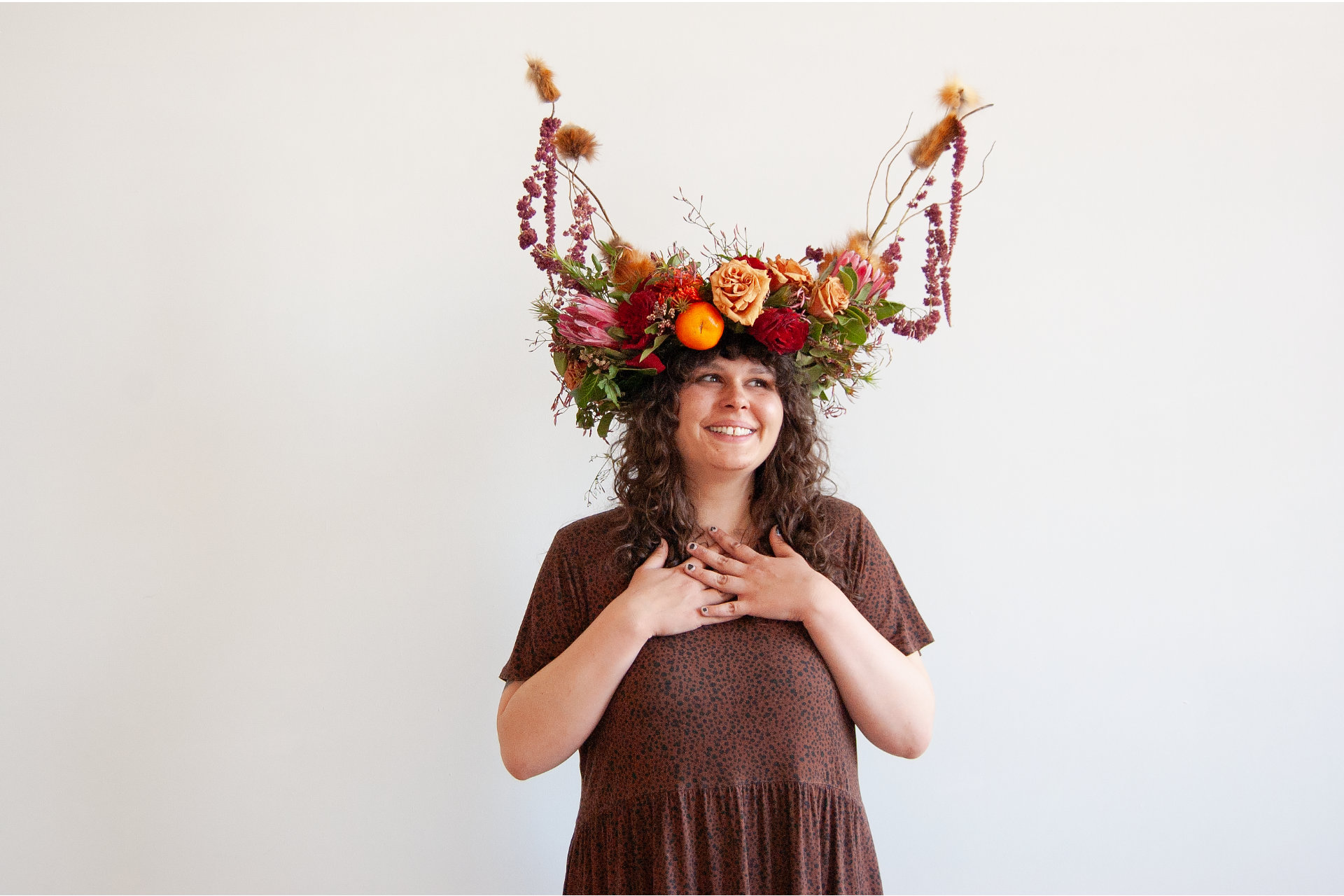
Sharifa: You know, I’ve never asked you this question before, but how did you select bustleworship as the name of your project?
Jensina: I was living in Lawrence, Kansas, for just a year. I moved there for someone and because I had a lack of direction, I ended up taking a community college course about historical garments. I loved bustles because unlike so many other Victorian garments, that were about construction and constriction, a bustle is about plumage and a voluminous expanse. During my time there, I met some wonderful, interesting people and we had a conversation one night about the overlap between punk and body culture. Specifically as it tied into straight edge movements and weight lifting, and how gaining strength, for some, became a way to fortify against institutional systems of power. And one of my friends said something about it being like muscle worship for this type of person. To which I was like—I love that—but for me it's bustle worship.
Sharifa: You've described bustleworship as being a persona, not just as the name of your company, but as an embodiment of you. I’d like to hear more about that.
Jensina: A lot happened in my early 30s when I decided to stop drinking. I noticed that I missed the social aspect and performance of getting ready to go out. I realized that I was more introverted, quiet, and shy than I had allowed myself to be. By leaning into the dress up factor, it was a way to access the physical transformation needed to be in a space with other people. Clothing was a way to elevate and change how I was perceived. It was an acknowledgement that to go out, I needed to armor myself as a newly sober person. The armor both protects me and projects a version of myself that is more comfortable in social situations.
Sharifa: I can relate to what you’ve said on several different levels about being introverted and with social interaction. With this in mind, I want to hear more about the role of play in adulthood and how adornment can provide a vehicle for experimentation.
Jensina: So much of normal adulthood is training us away from individuality to be a good citizen, or a good worker, or to fit in and be a “normal” adult. Through this process there’s a suppression that’s like pulling the air out of the room. So many people may say, “I love that, but I could never wear it.” If we allow ourselves to play, we allow a revolutionary act against homogenization. To play is to combat perfectionism in a way that can be healing and life changing.
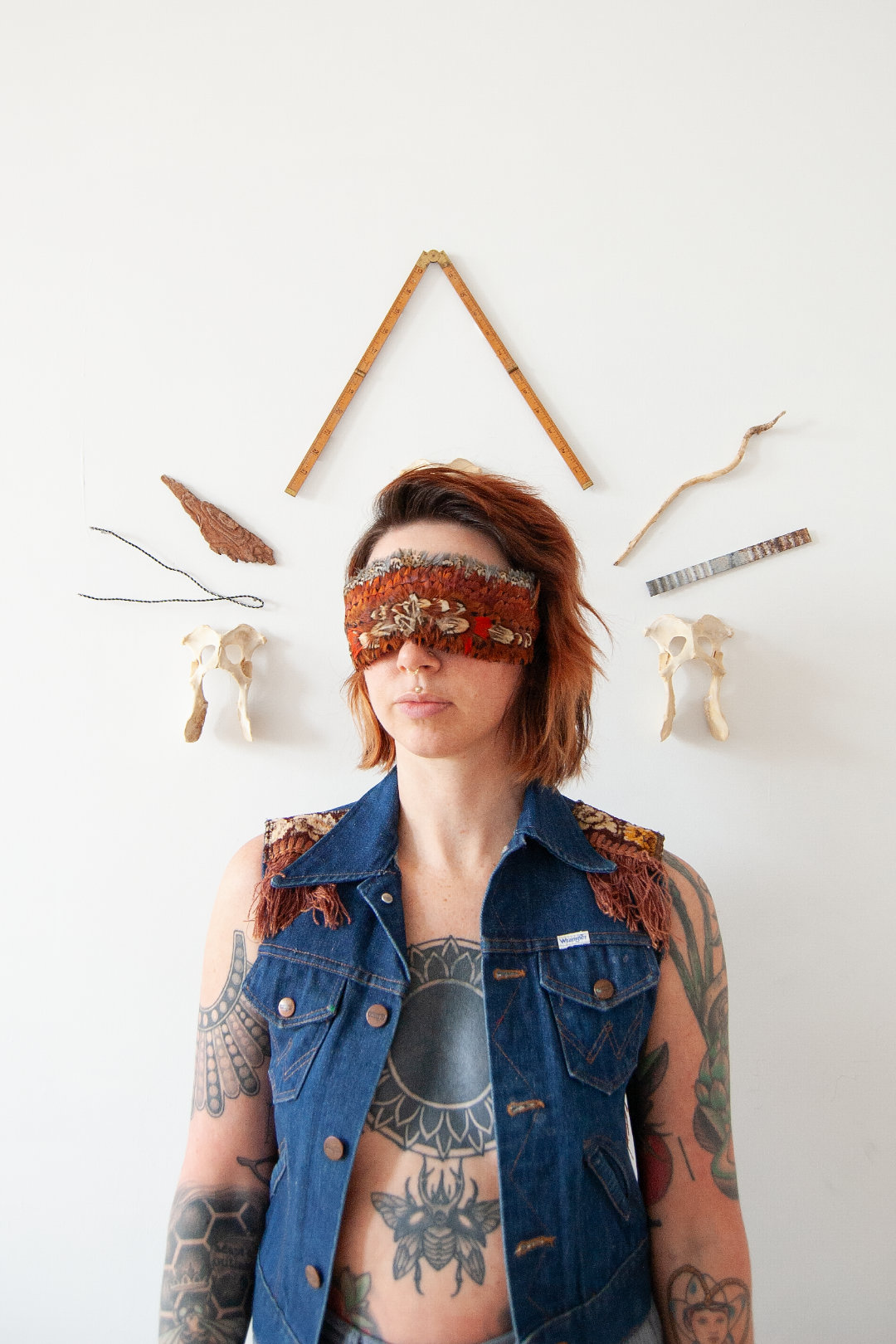
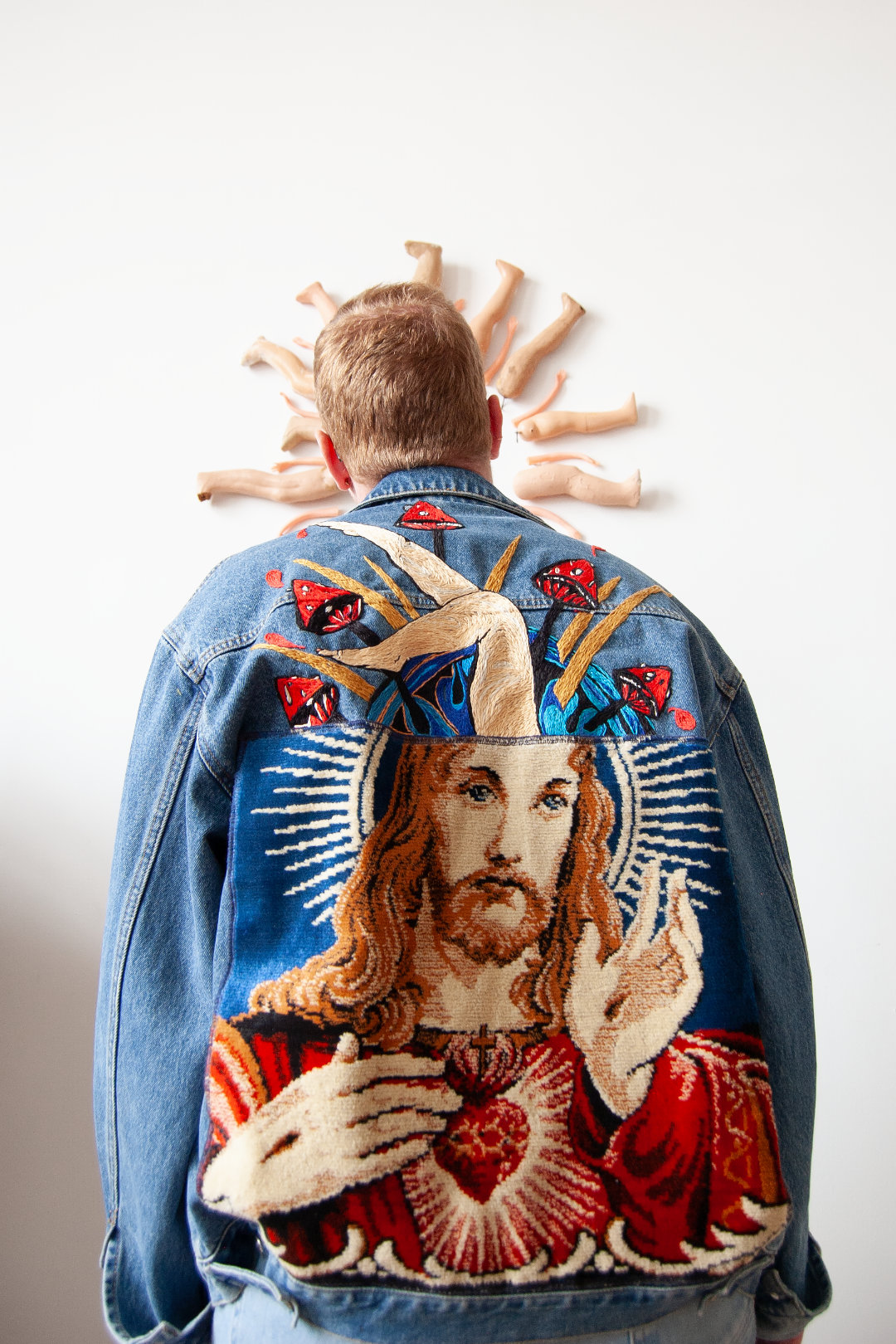
Fabric also has a way of revealing itself. After a pattern piece has been cut out of fabric that tells a visual story, there is sometimes a floating leg or another strange, jarring image that remains. I like the optical play of misreading a piece of clothing, like if you look quickly at a person across the street and it looks like there is an animal on their back, or another limb coming out of their silhouette. These things make us question the analog reality in a way that I think is interesting. I’m not a classically trained seamstress, where the ethos is to “measure twice, cut once.” Instead, I lean into play. I’m more of a never measure- throw fabric in the air to slice up with scissors. I’m an extremely perfectionistic person, and this practice helps me break those tendencies. I always create for me first and then for other people second. If you don’t like it, then it's not for you, and that's okay.
Sharifa: One of the most important aspects of any practice is the willingness to experiment, play, and to fail. Perfectionism prevents a lot of people from getting started because waiting for everything to be a certain way means that nothing will ever happen.
Jensina: That's so interesting. It made me think of when I first started working in museums on fashion exhibitions. I was so anxious because I'm not a sewist or a pattern maker. Then I looked at the garments. All the couture garments are made by hand. On the inside the stitches are uneven and they have faults. I like the idea that the reverence of handwork should be felt and seen.
Sharifa: It’s true when the fit is about how it looks on an actual body and all bodies are different. Couture items are not cookie cutter garments without variation.
Jensina: It’s the sign of a handmade item and why would we want to distance ourselves from the reality of production? I think of Diana Vreeland and how she said she wanted her living room to look like a garden in hell. I want my clothes to look like they’re for a band conductor for the circus of hell.
Sharifa: I agree, and I love this sentiment. Expressions of individuality are subversions of conformity. This is a good segue into sustainability and your work with fur, which I think combines all these aspects of your work together.
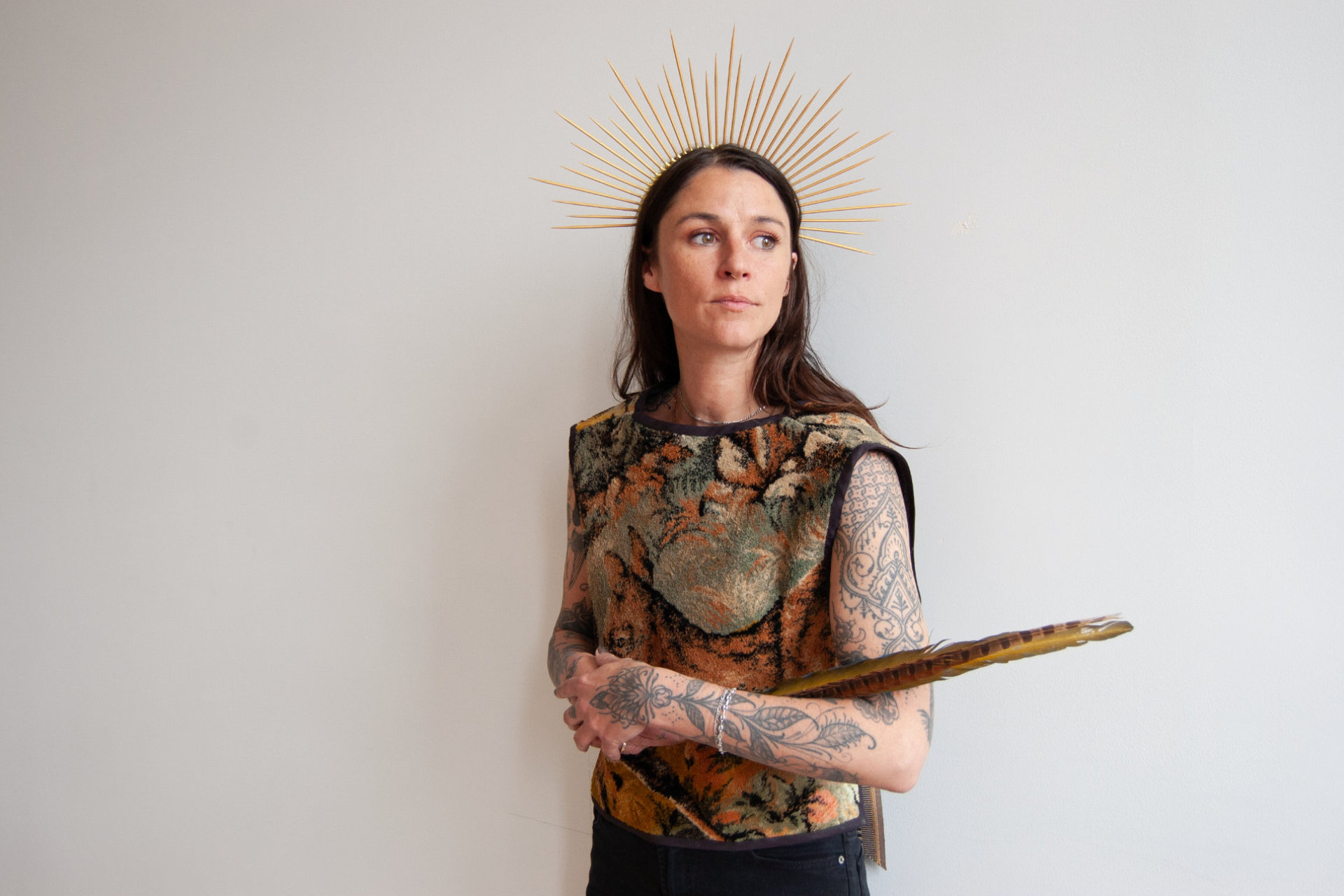
Jensina: When I first started buying and restoring garments after college, I was seeing a lot of fur coats and jackets. Some of these garments had major damage and some of them just had lining problems. Taking them apart was interesting to me because it helped me to see how they were produced. For example, mink has very structured, intense, linear seams, while rabbit has insane patchwork on the inside that looks like bursts of color where nothing is uniform. I started to think about the idea of the fur as an object that is biodegradable and by wearing it, you're honoring the animal, but also about the level of handiwork that went into it when it was made.
After 10 years of doing this on my own in the midwest, I found that there were still nine people in the US working in traditional methods of furrier work. I found a craftsman with 60 years experience in the Denver Metro area, and after meeting him I was offered a job. I literally went home, packed everything in my car, and lived on an air mattress at a friend's house for six months while I started my apprenticeship. It was not without challenges, but I'm super grateful for that experience. I ended up buying one of his machines, which I still use. So, I learned from a master of the craft, which is indispensable knowledge. In today's society, we want things to be fast and easy, and that experience was a laborious, slow, and painful way to learn something that added to my toolkit and supported my reverence for objects.
Sharifa: I appreciate this because it is knowledge that would otherwise be lost. I think it’s important to value items made with a high level of craftmanship rather than in favor of those that just fall apart. You’re doing the work towards keeping these types of practices alive. Not everyone would know that you are working with solely vintage fur. How do you address the anti-fur dialog in favor of the artificial?
Jensina: Well, fake fur is made from petroleum-based fibers that will never biodegrade but are also created through hazardous production methods. Fake furs continuously release microplastics when washed or worn. If anybody threw paint on me for wearing fur, I'd feel like I've made it, and I think it begs the question of where was your clothing made, from what, and by whom? While there is no ethical consumption under capitalism, the privileged hierarchy of assumptions can be damaging.
Sharifa: It’s true, and these items could end up in a landfill anyway, so the level of consciousness regarding what is already all around us is important to take note of. Obviously, all these topics exist on a spectrum in terms of personal beliefs and ideology, but often the arguments are rooted in misinformation, or replace one harmful practice with another.
Jensina: It’s interesting that you bring this up because people will throw away the $1 garment, but to throw away a vintage fur is to throw away the working-class history wrapped up in the production of fur.
Sharifa: There is a significant trajectory there, which extends into the dynamics and problems embedded in the history of the US. Speaking to the historical aspect though, tell me about your master’s degree research which gets into the weeds of this topic.
Jensina: My master's thesis focused on the intersections of sustainability and spirituality, and how those could be relayed through art history. I completed this work as both a project and a thesis. The project took place through a residency with Denver Digerati where I invited my friends and community in for a short interview and then allowed them to play with garments and other items of adornment in the studio, which I photographed.
During the Renaissance, artisanship and craftsmanship were revered and exalted. They used visual language to tell stories. I was thinking about how being an artist or an artisan in those eras was to be noble in its own way. In order to combat the draw of massive consumption, we must have reverence for the things that we already own. There is an obvious connection between fast fashion and climate change, but how do you shift foundational narratives about what is worthy of being saved, what is important, and what is beautiful?
So, for me, thinking about how my clothing, made from landfill fabric, could be portrayed as worthy was the basis for my masters project. I paired my research with the symbolism imbued onto images of saints in the Catholic religion, which is the religion I grew up with. By having the garment worn by someone in a way that emulated sainthood, it gave reverence and exalted the garment in a way that showed it as a thing of beauty. I wanted to subvert the contemporary drive for ubiquitous clothing, homogenization, and the gender binary. To play is to take power back. Play allows a moment of release and excitement.
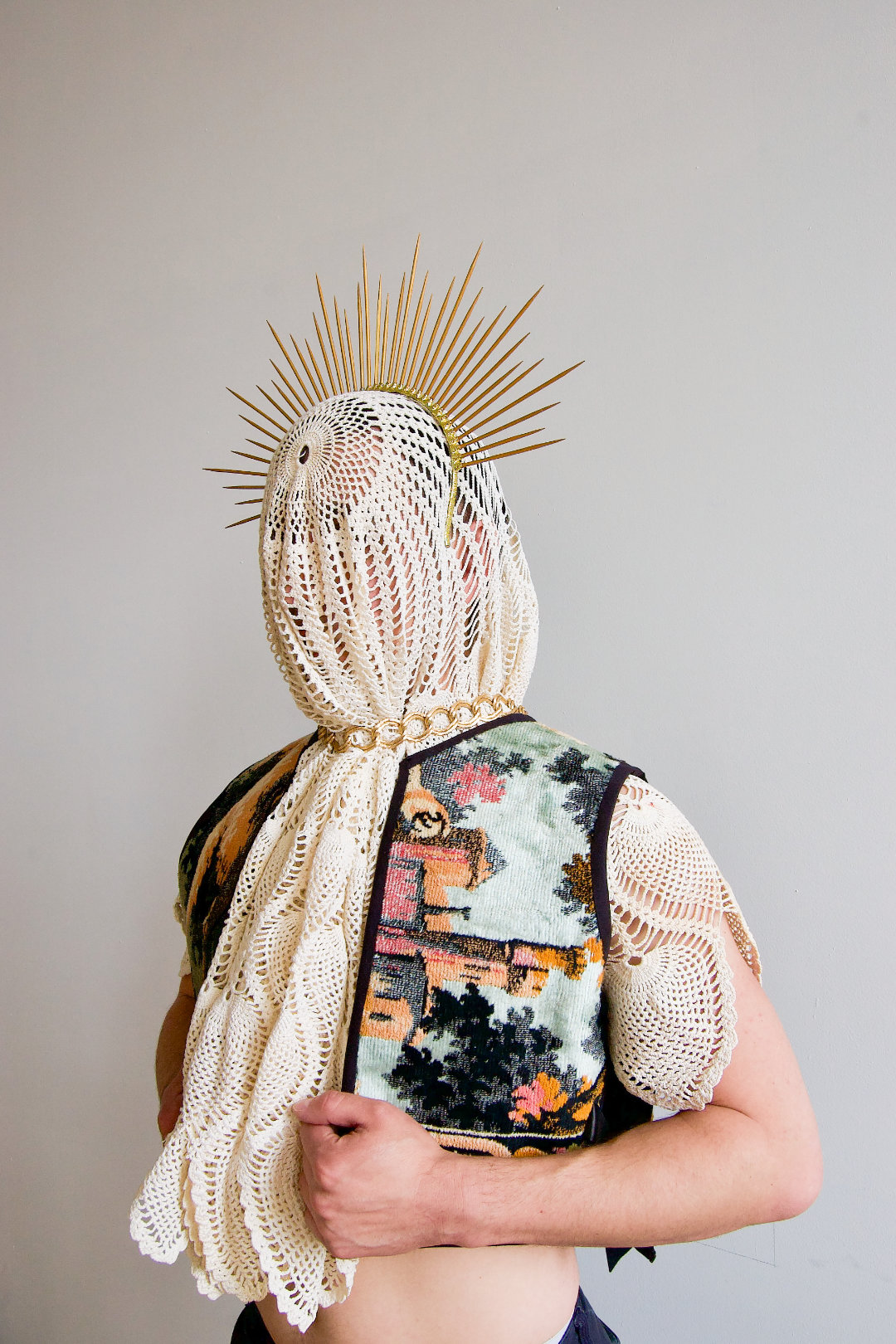
Sharifa: It’s the idea of play as a reclamation. This connection also reminds me of Orthodox practices with icons, where the object serves as a representation of the person being prayed to. The focus is not on the object itself, but on the spiritual presence it signifies. I appreciate how you are using the act of play to shift embedded symbolism into new meanings. In terms of breaking hierarchies, symbolism is only legible to people who share a common language and by creating a new dialog you are creating inclusivity. I have to say that I love the images of Queen John the most and feel that all these ideas connected through the act of play connects to this season for Tilt West strongly.
Jensina: I think Queen John was integral to getting into the space of play. Before people played “dress up,” I would ask them five questions, to set the intention for their session. The interview with Queen John is beautiful because he talks about how playing dress up provided self-revelation and self-love, and how it was his auntie of his who saw him in one of her 1980s sparkle sequined outfits. He said that when she mentioned it to him his response was, “I just want to shine on the outside, because I feel like I'm shining on the inside.” That's so sweet and speaks to the feeling of something bubbling inside of us that clothing allows to come to the surface.
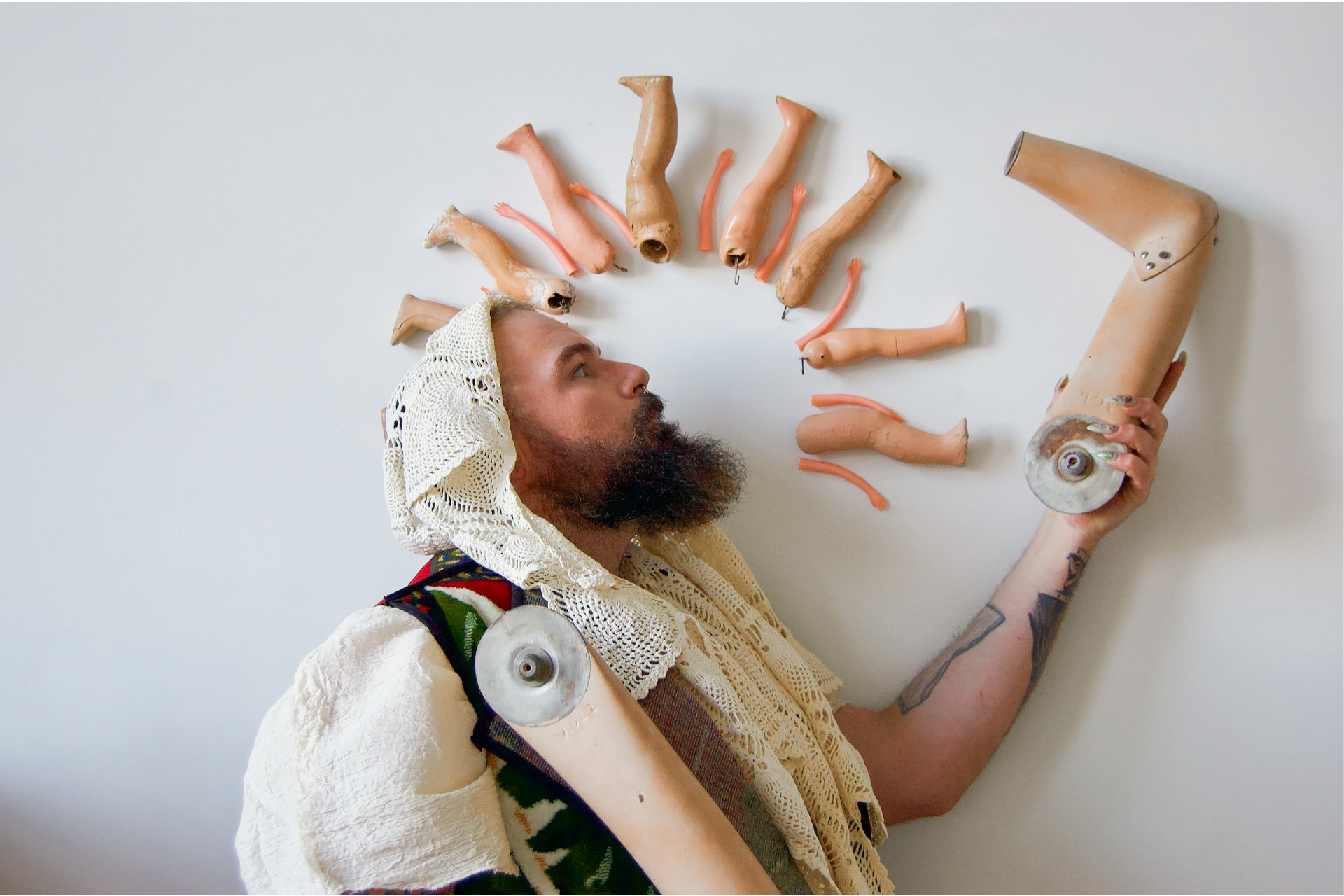
Sharifa: There's another aspect of this that is coming up for me as we're talking, and that’s where the role of privilege comes in. I feel like clothing marks our position in society in many ways, and so the allowance to be adventurous rejects the status quo, particularly where resourcefulness comes in. By being scrappy a person can push against the demarcation of privilege through individuality in garments. If you're resourceful, then you can create the look for yourself, and if you’re weird, people are usually drawn to it.
Jensina: Everything I make is out of objects that a lot of people would consider trash, but I make them beautiful, and accessible. I believe in the idea of open-source fashion—as in—patterns and material information should be shared. Why gatekeep because two sets of hands making “the same thing” will always produce different unique and creative results, and how you wear it is personal. It is so very important to see the possibility in yourself and others and knowing that transformation is attainable. I want clothing items to mutate my gender, my visual and physical body, to break out of the self-contained, which I think also creates a sense of empathy. When you can see yourself as containing multitudes, you are able to see others in that same light.
Sharifa: I agree completely. Thank you for sharing that. I enjoyed the photos and what they represent. What is next for you in the coming year?
Jensina: I have a new studio space, and I am excited to be able to set up my furrier machine, my 1936 chainstitch machine, and have a location in which to create more transformational work with fur and to expand my art practice. I’m exploring some women's-work, Divine Feminine concepts, by quilting butter wrappers. This project is looking at the macroeconomic theme of guns versus butter— how warfare, which is deemed more masculine, is prided in government systems over what is often considered feminine-based practices of community investment and care.
Sharifa: There is a lot of tension between these topics right now. I look forward to seeing this work develop and I think it’s going to be great. Thank you for taking the time to talk to me today.
Note: This essay will appear in the author’s forthcoming book, 10 Easy Steps to Creating a New Society.
One of the most notorious crises in the United States is the ugly and never-ending confrontational relationship between the State (the police) and communities of color, particularly African Americans. Before we take another step into this centuries-old dance of violence, let’s clarify a few points:
- While one can trace the practice of policing as far back historically as 27 BC in ancient Rome, the heart, soul and meat-on-the-bones of modern policing in the United States was inspired by the slave patrols of the southern states.
- Although more white people are killed by the police in the United States than other ethnic groups because of their sheer numbers, a much higher percentage of Black people are shot in high profile and questionable extrajudicial killings.
- The practice of authorities or police killing unarmed Black people has a 400 years old history in the US.
- The nation’s extraordinarily high incarceration rate of Black men relative to the overall incarceration rate in the world reflects a punitive, industrial construct.
- The dramatic level of income inequality in 2020, especially as it relates to race, is rooted in systems that have worked against Black wealth creation for centuries.
- Ongoing neighborhood segregation, under-funding of schools, under-employment, and general racial discrimination fuel a permanent underclass in the African American community that police departments are used to “keep in check.”
In many ways, police violence against Black people stems from an infrastructure that doesn’t value Black lives and that seeks to actively thwart efforts by Black and Brown people to create lives of quality and dignity.
I was recently invited to moderate an online panel discussion organized by Tilt West, a nonprofit dedicated to fostering conversation on art, humanity, and community. My fellow panelists included Wisdom Amouzou, an activist, diversity expert, and principal of Empower Community High School; Bianca Mikhan, a poet and artist who focuses on mental and spiritual health in marginalized communities; and Lady Speech, a spiritual coach and advocate for LGBTQ communities. We were invited to reflect on Black safety in the face of ongoing police violence. I started our conversation by asking that we reimagine what safety might be. Is it solely about protecting ourselves from those who seek to kill us? Or does the notion of Black safety provoke a deeper question about finding true security in the quality of our lives? Is it both and more?
Mikhan argued for an idea of safety that reaches beyond our individual selves so that we may survive and thrive collectively. She believes that true safety is found in compassion. Mikhan’s remarks raised hard questions about humanity. She reflected on the fact that some people have responded to the COVID19 pandemic by buying guns, while others have baked bread. She said that we’ve been forced to ask the question of who we want to be as a society when we grow up, which provokes further questions such as whether we believe that people are fundamentally good. For Mikahn, it is our ability to apply our greatest selves to small domestic challenges that prepares us to create a bigger, better version of humanity.
Amouzou asserted that a truly safe environment requires three essential elements: freedom from threat, or not having to deal with the possibility of death on an ongoing basis; freedom from fear, or accepting that threat is part of the human experience; and peace, or living in a world where you can successfully manage threat and fear.
Lady Speech made the case that true safety is rooted in our relationship with Mother Earth. The broken relationship between humanity and the Earth creates the conditions which lead to state-sponsored violence. White supremacy and capitalism have disconnected us from Mother Earth and have resulted in a fear-based approach to life that shows up in all of our institutions. Lady Speech added that the 400 years of violence inflicted on African Americans has not been lost on Mother Earth, who is responding to the energy of this pain and trauma.
Our conversation also touched on what it feels like to walk around in a state of constant fear. Amouzou suggested that he manages this fear by mentally and emotionally departing from America. Mikhan responded that this kind of mental departure is essential to survival in American society. By contrast, Lady Speech believes that we must first come to terms with our traumatic history; we must acknowledge the effects that our violent history has on the present, by seeing the ways that the rapes of children and adults that were a common part of the African American slave experience impact our community even today.
My conversation with these three seers led me to create a list of seven ways that we might establish true safety and make it a way of life going forward.
1. Bring back our connection to our ancestors. One of the most common indigenous African philosophical constructs is the idea of ancestral veneration. A basic scientific principle is that energy is never destroyed; it is simply transformed. This principle must also apply to human energy. Ancient people understood this as a basic truth of human experience and felt profound, ongoing connection with their ancestors. This connection helped them face challenges from a position of strength and with a perception of protection and safety.
2. Embrace Ubuntu. Ancestral veneration is rooted in the concept of Ubuntu. This idea says that “a person is a person because of other persons.” In other words, none of us exists alone; we are not really individuals. We belong to a collective of people who have existed for millenia. This understanding stands in direct conflict with the Western notion of rugged individualism. True safety may be found by tapping into the genetic memory of that indigenous wisdom.
3. Take the painting off the wall. If you go back far enough (and sometimes not that far) almost every ethnic group has used song and dance, not for the purpose of artistic display, but as an integrated part of daily life. Somehow, in Western civilization, art has become something we collect and view at a distance, like a painting on the wall of a museum. Perhaps re-engaging with spontaneous music and dance would bring us closer to a way of life more in keeping with a safe environment. There is safety in the release provided by song and dance.
4. Focus on quality of life. One of my own anecdotal observations is that when people have a decent quality of life, they are less likely to accept an unsafe environment. They become committed to maintaining their safety, the safety of their family, and the safety of their community. Conversely, when people’s lives are precarious, they will often end up in unpredictable, perilous, and unsafe circumstances. The math here is not that hard.
5. Defund the police. Yes, I know this phrase is a lightning rod, but that’s only because it has been highly politicized. Something is genuinely amiss with police funding. According to a New York TImes report from June 12th, 2020, city police budgets across the country have risen by millions of dollars annually — even during lean years for city finances, and even despite a steep nationwide decline in violent crime that began in the early 1990s. More dollars are being funneled to police departments to fight the “ghost” of an out-of-control crime rate, and this has come at the expense of funding for other city services. Police departments have also grown more militarized, equipped with assault-style weapons and even tanks from arms makers. “Defunding the police” doesn’t mean eliminating police from your city. It simply means that resources should be focused on necessary services that address mental health, food scarcity, addiction, and other challenges that have been exacerbated by massive income inequality, and not merely on adding more armed men and women on the streets, which often only invites violent altercations. Police budgets should not be tied to political whim, but to overall crime trends and statistics. Science, data, and truth should still matter.
6. Support Relationships. The more we devote time and resources to developing and strengthening relationships among family and friends, the more we can tap into those relationships to help family members overcome challenges instead of leaving that responsibility to the police. Traditionally, family has been the first line of defense in a crisis. Without this support, we call on the police to step in where family could be the first call. Of course, there are times when the police should be called, but imagine a society that supports families and provides more family-based services.
7. Stop creating the “Procariat.”If you combine the words precarious (unstable) with proletariat (working class), you create the word Procariat. Millions of Americans live the life of the Procariat — the unstable working class — especially African Americans. If you cannot plan for the next eighteen months, you are living an unsafe life. If your household is food insecure, you are living an unsafe life. If you don’t know where your next paycheck will come from, you are living an unsafe life. When we start to address these issues, we will improve safety for African Americans and halt the perpetuation of the Procariat.
We have opportunities to do something about safety; they are not beyond us. They don’t even require us to leave the comfort of our homes. They do, however, require a shared philosophy of Ubuntu that helps us understand that when others around us are unsafe, we are all unsafe.
How to Be A Witch, Wizard, or Warlock in Today’s Economy
Those who sought the illusion — it is done
Outdated bones impose the mundane
To discover the True
Do so with nothing
Seek not belief to remain
Hang up on people in real life the way they hang up on people in movies
Raise your right hand to the heavens and bring down
lightning to match the ground
It’s possible to communicate directly with
your chosen reality initiations
Become manifestations of The Witch
Who would say that pleasure isn’t useful?
The Witch always tells me to form the defeat
and make off with the storm
as an act of makeup
and lack of academy
Let the cowards of false kindness
mistake power for magick
Let them have their placards
& petty commendations
Beware of tricks
says The Witch —
Stick with spells
We, Patron Saints of Troubled Times
We
bang our heads
in a whisper, screaming
to a lord We don’t think
maybe might be out there
All of our altars
rendered hollow wind
candles blown out, waiting
despite heaven’s backlog
for so many candidates to
finally be canonized
Reaching for the
language of ordainment
its distance further all the time
not realizing We are all
already fluent
Kingdom Come
ain’t coming through
so We must seize the
means of production and
baptize our own damned selves
Act as ye have faith
and faith shall be given
to We
But We is not
an empty office
Our newfound abilities
must be brought to bear
transmute thoughts and prayers
into actions both grand and fragile
Be of service to one and other
with no thought of reward
no fanfare or tithing
no pedestal or pulpit
We are all We and
no one stands higher
than anyone
Ibadan
auntie grows ewedu in the backyard
Ibadan is a handful of lemongrass boiled with rainwater
the purest form of my father I know
here, he smiles in love letters to old girlfriends
runs his fingers through the rusted gate of his elementary school
and we all breathe easier here
the generator is twisted into ivy breaking through the brick of the outer gate
the red dirt marks everything
coats uncle’s pressed suit
grows into your blood
follows you the way a souvenir cannot
this is unconquerable land
wildflowers have overtaken the old foreign tire company
your sugar does not grow here
I’ve never met a land that rains like your grandmother bathing you
scraping with wise hands in a tin bucket
this is where I want my bones rested
where the sun is always showing off
where poverty is just another word the British made up
where the melon vines stretch eagerly up to our urging hands
Here
We are familiar with laughter
The way America is familiar with debt
We live
Loud and up close
Off-grid
Off-schedule
Here
We
Know
How
To
Live
Ghazal for Spring
For now, let us hang our pain and worry on the closest hook
and admire the army of tulips stretching outside, it is spring.
If you will, turn off the news and be still for a moment,
listen to the loud sound of silence that sings, it is spring.
The coyotes and deer and bear have begun to reclaim the land
the water is clearer, the air fresh, the fish are swimming, it is spring.
Mother Earth is shedding the old like a snake, curando heridas abiertas
showing us the love in sacrifice and growth; que hermoso, verdad? Es Primavera.
Chase the smile welling inside you, even if you feel that it’s fleeting,
it is proof the sun always has your back, it is spring.
Do not walk around the promise of new beginnings as if tomorrow will
foolishly repeat the mistakes of yesterday; seeds are sprouting, it is spring.
Forget not, there is a warm body in front of each shadow,
a heart beating, a mind conspiring, a spirit opening, it is spring.
This morning, entangled bodies made love as the cold rain fell softly outside,
physical distance morphing into metaphor; climax, equinox, it is spring.
The wind is howling outside, the hood is a siren that’s not sounding,
I’m contemplating what will blossom from all of this, it is spring.
soul (noun)
the principle of life, feeling, thought, and action in humans, regarded as a distinct entity separate from the body, and commonly held to be separable in existence from the body
philanthropy (noun, plural: philanthropies)
altruistic concern for human welfare and advancement
If you believe you are too small to make a difference, you haven’t yet spent the night with a mosquito. — African proverb
Giving First
by Bianca Mikahn
Awe inspiring collectives can
be found in the tiniest corners of nature
Neurons, insects, birds
like starlings blanketing the sky
To live
Thrive
to have enough
maybe to distribute
in spite of inhibited acquisition
Inflate new ideas with pressed upon lungs
lift upon air with seemingly clipped wings
manifest this philanthropic soul
We’ve always built the boots and the straps
and the sinew tensed for pulling
We’ve always responded to struggle with familiar capability
an extra ladle dished onto an unplanned plate
an extra blanket on a bed laced
foot to head to foot with cousins
giving first
Consistent solemn promises to never stand idle
in the face of our brethren’s need
in the face of our sistren’s loss
in the face of vicious threat
There is active work to inhibit our vision
machines reading biometrics as though a computer camera
could recognize our flesh more clearly than a neighbor’s caring eye
This narrative of destitution endless, monolithic
almost always inaccurately reported
I’ve never met a welfare queen, only families in need
Of course currency is a limited tool
truthfully the weakest resource we own
It cannot respond and understand the way a heart might
does not plan and engage the way a mind might
Capitally seems to allow mastery of life experience
but experience was not always currency’s pet
once it roamed unbridled in the countenance of tribes and villages
general understanding of our inherent value
How does humanity save itself
from the maw of industrial greed
how do we fly free without risking ourselves prey
In these schools, swarms, herds, flocks
We could be the murmuration of the starlings
Each winged partner coordinating
with its seven most immediate counterparts
Creating a pulsing cloud of iridescent black
a visual spectacle of thousands sweeping pulling dipping redoubling
This phenomenon actually born an illustrious dance of defense
no scientist able to identify how such vast flocks maneuver
with complete cohesion
infinite lives spared through responding to neighbors with
speed grace and accuracy
no single fowl leading the flock
all movements governed collectively maintaining motion so fluid
it makes the blood in our human veins ache and race with wonder
This intimacy with wind currents
this result of countless butterfly effects
crashing over each other’s inevitability
tidal wave tendencies
tipping points defying gravity
organizing for the sake of survival
Beautiful causation in response to considerable peril
not just our capability, but our responsibility
Every finger and feather and wing and buck and prayer essential
One might think in this fecund wilderness of a world
only the largest most aggressive entities are allowed to procure safety
But the numbers we might find our strength in are endless
and brilliantly adept at converting the horizon into vistas of sweeping change
When our little pieces adjust into the perfect places
we ascend
a pulsing sky bound mosaic
Lifting past the antiquated naysayers
And back into the soaring arms
of our people
A Letter to Black Femmes
Black femme.
You night sky,
You starless galaxy
You
stars for eyes.
You
are so full of empty
of womb
of creation
You
balance of holy fire
You misunderstanding
You
misunderstood
You
so beautiful
so lawless
so… dark
They branded you that, you know?
“dark,” “black,” “demon,”
You
all reclamation
all “yin,” “rebirth,”
You
beaten spine still straight
you clawed teeth
you rip them apart with rhetoric
and discourse.
You
all community,
all let’s talk this through
all “What is ailing you, my love?”
Them
tired of hearing about how black you are,
How straight your hair is not
Wishing
you’d just blend in
Wishing you’d stop being all bold colored font
You
all redefining black as beautiful
nappy as galaxy
You all proud
them all scared
You not running
them all shaking.
You
You
You
stand tall against the wind
You recognize your skin as baobab tree
You all deeply rooted
You
wondering about your roots
on a land that feels like sand
You clinging onto the depths of empty
You know empty
You’ve claimed it
made it friend
You know what happens here,
in a starless night,
in a planet-less galaxy
in the largest womb ever known.
Here
is where you have always
created best