One of the greatest barriers to moving outside your comfort zone in life is the fear that you’re not worthy. Feeling like an imposter — like you’re not good enough and other people are going to see right through you. This was my biggest fear growing up, that I would be ‘found out.’ My parents were immigrants, and I spent many years trying to find a sense of belonging. The community I grew up in was mostly white and conservative, so there weren’t many people with my background, let alone those who could relate to my experience as the child of immigrants.
Experiencing self-doubt and insecurity about our place in the world is actually very common, but it cripples many of us to the point that we can’t put our best foot forward. We’re not able to project real confidence or enthusiasm or passion in the things we do, and we’re not able to truly show what we’re capable of because we shrink in the face of our perceived inadequacy.
Perhaps the biggest villain in all of our lives is this feeling that we’re going to be ‘found out.’ So we put on a mask, or many masks. We pretend to be whoever or whatever we need to be — who we think other people expect or want us to be — in order to fit in. I did this. I became whatever my environment told me I needed to be. I hid behind a mask, because masks shield us from close scrutiny. We wear them because we’re scared. We’re scared of being seen or noticed, and of not measuring up. We tell ourselves that without the mask, others will realise that we’re not supposed to be here. And that idea is a heartbreak so inconsolable that we do everything we can to avoid it.
I wonder how many people put masks on as they step out into the world. Is it all of us? Do we all leave our true selves behind in some way while we search for our place in society? I want you to ask yourself what masks you wear. Are you afraid of rejection, a people pleaser, in need of validation, or are you trying to hide a vulnerability and protect yourself? Maybe you’ve guarded yourself in the past because you were worried about being misunderstood. This desire to belong is human, but when we mold ourselves into who we think others want us to be, we’re not able to live up to our true potential. We’re not able to bring everything about us and all of who we are to all that we do. We dim our light in a world that needs to be lit up, in a world that is already dark and gloomy.

Something that has become even more apparent during this pandemic is how important it is to have strong connections and relationships in our lives. How connected we feel to others is actually a strong predictor of our feelings of self worth and happiness. And the more deeply connected we are with others, the more meaning and purpose we have in our lives. Even our neurobiology tells us that we are wired for connection. Connection increases levels of oxytocin, a hormone that acts as a neurotransmitter in our brains to build feelings of trust.
When we wear our masks, though, we’re not able to really connect with those around us, because we’re not able to be our authentic selves. We withhold parts of ourselves, and that withholding can limit our ability to build deep trust. We are left feeling disconnected and lonely, which floods our body with cortisol, the ‘flight or fight’ hormone. Our feelings of social and emotional anxiety are heightened, and we fall further into the trap of thinking that we need to be somebody else to belong. So we wear our masks. How else will we fit into a world that doesn’t understand us? How else will we find those connections that we so desperately crave?
The truth is that we’ll never be able to truly connect if we’re carving out pieces of who we really are. I’m still coming to terms with this in my own life. I’m trying to strip away this facade. I hope I can one day find the courage to leave all of my masks at home. Then I will truly be seen, and I’ll be able to share my gifts with the world.
But maybe that’s also a facade. Maybe the world doesn’t want to see me. Maybe I won’t ever be accepted, since exclusion has been the universal experience of every minority in every land across the globe. The mask is a way to counter the labels and stereotypes that others have placed on me. I am more than my identity, and the mask protects me from inequities that exist in the world. Yes, like everyone, I crave connection, but in the face of indifference and rejection, I yearn for safety even more. And the mask keeps me safe. Maybe it’s who I really am. Maybe it’s who we all really are.
“We are listening,” was a refrain that sounded from nearly all quarters of American commerce during the summer of 2020. Across the United States, for-profit and non-profit institutions alike pledged to listen harder, learn more, and become more sensitive to the causes and effects of systemic racism. In the wake of still more Black lives lost to violence at the hands of law enforcement and the wave of protests and advocacy from the Black Lives Matter movement, institutions in the art world and beyond were forced to reckon with the fallibility of their organizational structures, and their own roles in perpetuating racist ideologies. Perhaps for the first time in the museum field since its inception, there was an industry-wide display of humility. Institutions both large and small acknowledged that the existing frameworks needed to change, and that listening was perhaps one of the most important tasks ahead in their path towards improvement.
At present it is an open question whether these pledges from institutions will lead to substantive or lasting change. In the meantime, I find it interesting to consider what this sweeping acknowledgement of the role of listening means for a field of art whose existence pivots on being heard. What could expansive listening mean for the future of sound art? For years I have loved engaging with works of sound art because they have heightened my perception of sounds that are beautiful, layered, complex, and at times challenging and strange. Now I am asking if this medium has (or has had?) the ability to also fire the synapses in our brain that make us more empathic, more receptive, and more willing to change to accommodate the needs of others. In the Tilt West roundtable discussion, it was expressed that “listening requires one to give of oneself.” This definition shifts the act of listening from a passive act (albeit one which requires perceptiveness) to one which demands that after hearing something we cannot remain the same.
Generally speaking, the type of listening demanded by movements such as Black Lives Matter is not about the literal perception of sounds. It focuses rather on the decentralizing of authority, the recognition of BIPOC voices, and the inclusion of those voices in decision-making spaces as ways of ending the deleterious effects of racism. In this context, listening has to do with the absorption of speech and ideas, and it does not end with perception but with action. Listening is not the end game but, rather, a means to an end. For this change to happen, institutions have to become more porous and less didactic. This ties in with what roundtable prompter Nathan Hall posits as a possible future for sound art: that it may become not only about putting sound into the world but also about eliciting a two-way dialogue. Tilt West host Bianca Mikahn linked this approach to the Black lineage of “call and response;” an action is not complete until it receives a response.

If sound art is now securely accepted within the canon of art history, then arguably it bears scrutinizing which stories are being told and whose sounds are being heard. Two examples of artworks that advance the sounds of under recognized voices are Tania Candiani’s Pulso and Postcommodity’s The Ears Between Worlds are Always Speaking. In 2016 Tania Candiani orchestrated the performance Pulso (Spanish for “Pulse”) in the subway system of Mexico City. This one-day performance comprised of 195 women playing pre-Hispanic drums in the tunnels, stairways, and corridors of the Metro, filling the spaces with indigenous-inspired percussive beats. The project centered on the artist asking, “What is the pulse of Mexico City today, and is it possible to recover the ancient pulse of an old Aztec city?” Employing instruments traditionally played only by men, the artwork addresses the role of women in society. In 2017, the indigenous art collective Postcommodity created The Ears Between Worlds are Always Speaking, which was broadcast into ancient grounds of Aristotle’s Lyceum of Athens, Greece as part of Documenta 14. This “hyperdirectional opera” encompassing oral stories and recorded vocals told by migrants based in North America, Syria, and the Middle East was projected from two Long Range Acoustic Devices or LRADs. Acknowledging the ongoing tragedies associated with mass migrations globally, Postcommodity artist Raven Chacon explained, “In this work, we are also considering examples of forced migration in North America, like The Trail of Tears when the Cherokee Nation were forced from their lands and relocated to Oklahoma, and The Long Walk, the deportation of the Navajo people.” In this context, LRADs, which are devices often used by the military or police to disperse crowds, have been reconstituted into instruments for teaching. They ask us to listen to voices that have historically gone unnoticed.
Words can do harm, and so can the feeling of being unheard. During our discussion on deep listening Mikahn shared: “Deep listening is the most important thing in my world, because I am often very unheard. Extremely, egregiously unheard.” With this in mind, how can we tilt sound art towards listening so that it is not solely focused on the creation of sound? The term “deep listening,” as Nathan Hall acknowledged, comes from queer sound artist and pioneer composer Pauline Oliveros. Oliveros has defined deep listening as a practice of radical attentiveness, where listening is an inherently empathetic act, requiring receptivity to the intentions of others and the natural world. Currently, with the advent of multi-million-dollar NFTs, resistance to digitally-based artworks is rapidly evaporating, and my hope is that this will have positive ramifications for the lives and livelihoods of sound artists. The next challenge for sound art, after overcoming the intangibility of its medium, is perhaps exploring the elusive nature of listening, an invisible process that occurs in the mind both individually and collectively. How do we encourage listening? How do we know if it has happened? And how do ensure that others feel heard? Sound has always been about reciprocity. The frontier is arguably about our ability to process a more diverse range of sounds, hold them in our minds, and integrate their implications into our daily lives.
We are a nation divided — this much seems clear no matter what part of the political spectrum you hail from. And it has me worried, not because I think we all need to believe the same things but because we can’t even agree on what to disagree on. Meaning: shared beliefs on what constitutes basic “facts” have become rhetorical weapons in a war of competing realities.
I suppose I saw it coming over a decade ago, when people were disputing that Barack Obama was born in Hawaii, arguing that he wasn’t a US citizen and wasn’t a Christian, despite his claims (and evidence) to support what seemed irrefutable facts about his identity. I recently watched a CNN news piece in which a reporter discussed with a QANON supporter that there was no evidence to support the assertion that Hollywood elites were running an underground pedophile ring. The QANON supporter said that the lack of evidence was actually evidence of it happening.
I don’t even know how to respond to that, so let me just repeat this so you can sit with it: the lack of evidence is evidence itself.
I was interested in the T\LT WEST roundtable, “The Semiotics of the Stay-At-Home,” because I’ve been thinking a lot about what it means to be sheltering-in-place. I’m interested in signs and symbols related to quarantine and COVID-19, especially the politics of it all. And when I say politics, I mean both ideological and electoral — politics have been front and center of my thinking about our global pandemic given the inadequate leadership at the federal level. That artist/roundtable prompter Rebecca Vaughan would be leading us through her process of baking sourdough bread seemed like a great bonus, since I love food and am fascinated by the symbolism of foodways.
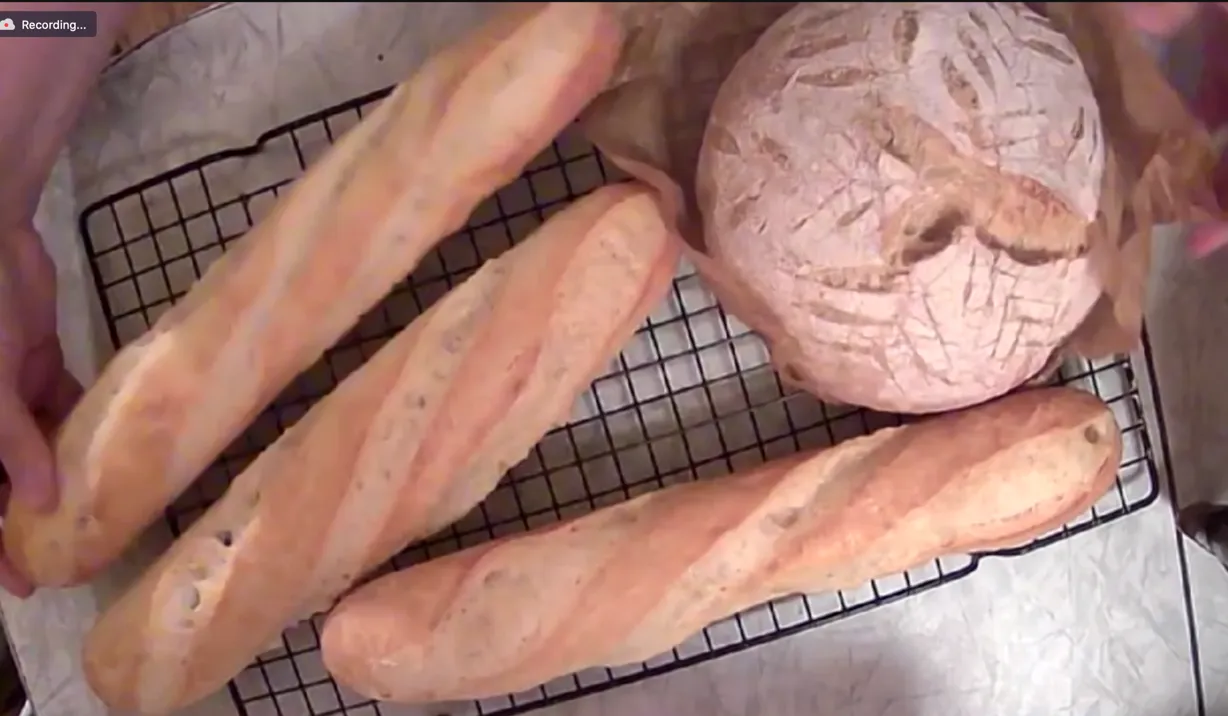
This was my first T\LT WEST event, so I wasn’t sure if the demographics of those in the room, at least optically speaking, were typical or not. It seemed all of us save two people were female-identified or perhaps a more accurate way of putting this was that only two out of 18 participants used male pronouns in their Zoom name and/or when they spoke about themselves. Only four of the 18 seemed optically not to be white, though again that’s more difficult to suss out since there are white-appearing Latinx, Indigenous, and multiracial people. Certainly all of us had enough technological know-how to be on Zoom, and since these events are by invitation to those on the T\LT WEST mailing list, my best guess was that most of us had some level of college education, some knowledge of what terms like “semiotics” means, some connection to arts, literature, humanities, and/or non-profit work, and I’d have placed bets that none of us had voted for the current president in the US elections that took place the week before.
You may be wondering why I was paying attention to demographics, so now is the time for me to say: I always pay attention to demographics. I don’t know how unique I am, but I’m guessing that finding myself “the only one” in a room more often than not is one reason I am habituated to seeing who else may be “like me” in any situation I find myself in. And by “like me” I will just say that while it seems my racial difference has been one of the most obvious and salient forms of difference that finds me “the only one” most of the time, I’ve also found myself a minority in other ways: in my political views, in what I research, in my gender, and — in this Zoom room — I was probably one of the few, if only, people who doesn’t like sourdough bread, or really any fermented foods; beer, kombucha, and sauerkraut just don’t do it for me.
For roughly the first hour the conversation felt like one you’d have with the demographics of this group of people — a lot of acknowledgement of our privilege and disclosing how we were coping with COVID-19 and staying at home. Different projects — food, art, crafts — were shared, and, for the most part, things felt polite, cautious, and respectful, like what you would hear at a Quaker meeting as people made statements that weren’t necessarily in response to anyone else — more sharing than dialogue or conversation.
And then I asked the question that had been on my mind: if sourdough is the symbol of an elite liberal left, what is the equivalent for the MAGA conservative Republican?
I suppose one could and should quibble with my assertion that sourdough, bread or otherwise, is a food symbol of the elite overly-educated middle-class left-leaning liberal. And I do not have a lot of people in my social circles who identify as right-leaning MAGA-supporting conservatives, so my belief that they may not also be staying at home, tending to their sourdough starter, feeling isolated because of COVID, and talking about microbiomes on our bodies and ecosystems — may be completely off. But I have increasingly been feeling like my reality is not the same reality of many people — certainly not of the nearly 74 million people who voted for a second term of our current president. And I don’t know that I can make any sense of that.
Maybe I’m a one issue voter (that issue being human rights), but I can’t make sense of voting for someone who incarcerated children at the US southern border, effectually kidnapping them and causing 545 of them to be orphaned. I can’t make sense of someone who won’t disavow white supremacists, and who claimed there were fine people “on both sides” at the Charlottesville pro-white supremacy demonstration. And I can’t make sense of voting for someone who has politicized mask wearing and doesn’t support basic public health, medical, and science recommendations for how to conduct yourself during a global pandemic.
So I wanted to know what everyone else thought about the semiotics of sourdough as symbolic of a type of person, one that seemed to be like the people in the roundtable’s Zoom room and not like the people I see on TV that were protesting election results in Arizona, Pennsylvania, and Georgia. If sourdough is the emblem of the stay-at-home left-leaning liberal, what do we think the MAGA conservative is making during their COVID-19 stay-at-home time? What followed was a lively and not altogether harmonious discussion about those of us on the left, those on the right, evangelical Christians who make kombucha, Amish who practice artisanal crafts, people on the right from more working-class and working-poor backgrounds who bake bread out of necessity rather than craft, and a gentle admonishment from another woman of color in the room about “othering” Republicans, combined with her belief that we are all more alike than unalike, no matter our political differences.
I’m genuinely not so sure about the last point. I’ll take being admonished for my othering of MAGA supporters. I am othering them. I don’t wish to demonize anyone, truly. It’s just this: I know I am not considered a fully enfranchised human being deserving of the same rights and respect as a white American man by a fair sector of US society and a fair number of people who wear red “Make America Great Again” hats. The exponential rise of anti-Asian violence and harassment in the wake of COVID-19 reinforces my forever foreign status. The fact that I am a hyphenated Chinese-American and not someone who is identified solely and simply as “American” is proof of this.
So, too, is the fact that women continue to be treated as second-class citizens. One recent example can be seen in the announcement that President-elect Biden has selected an all-female communication team. Don’t get me wrong — I’m very happy that the seven members of the senior communication team for Biden and Harris will be all women, with half optically appearing as non-white women. But this shouldn’t be news in the second decade of the 21st century. It shouldn’t have taken this long to elect the first woman Vice President, to have women play such prominent roles in politics, and for people of color to be recognized for what they are: fully enfranchised humans who should not have to fear that being pulled over by a police officer may result in their death, or that their desire to come to the US will be met with hostility and the false conviction that they are coming here to steal from US citizens, or that, if their religious beliefs differ from the Judeo-Christian system, those beliefs will be used as a reason to question their patriotism or citizenship status.
The semiotics of staying at home are probably not the same for me, the PhD ethnic studies professor who is in an inter-racial marriage and who owns a home in Boulder County, as they are for a white, Christian, evangelical high school graduate who works a retail shift at Target in Montrose County. But honestly, I have no idea. And that’s part of the problem. There is so much division in the US — so much strife, mistrust, so many bad feelings, and a conviction that anyone who voted for the person you believe would ruin the country must not share your values, culture, and foodstuffs.
I’m open to sharing space with someone whose political views don’t match mine — but we’d have to establish some common ground first. For one thing, I’d have to know that they view me as a fully enfranchised human being, and it would go a long way to know that they don’t think COVID-19 is a hoax and that they believe in wearing a mask. I’m not sure how to overcome the divided state of America that we find ourselves in, but I hope we can find common ground and facts we can agree on, even if where we land is disagreement. After years of disinformation campaigns, agreeing to disagree may just be the only state we can imagine, even if the glass-half-full part of me would like to imagine a united state of being.
In March of 2020, the country was forced into introversion at the onset of a worldwide pandemic. A “safer at home” mandate was put in place to save as many people as possible from the threat of a widespread infection, yet the result forced many people to face unsafe circumstances at home. We were forced to deal with our families, our personalities, our thoughts, our addictions. We were forced to see one another, vulnerable and scared, with no means of escape. For some of us, the world was safer than our homes. For many others, the world was never safe.
After 2 months of collective self-reflection, we found some semblance of unity in that we were all suffering together. Together. We were all at home and miserable in our own existence.
Then George Floyd was murdered…
and the country went into an uproar.
People protested, many who had never protested before. Brown people and white people stood alongside one another, supporting each other and supporting themselves. There was more collective suffering, a collective experience of trauma.
The word trauma, in fact, has an interesting history. According to the Ngram Viewer, usage of the word has spiked since the 1950s and 60s. What was happening in the 50s and 60s? Race riots. What was happening before? Racial inequality, racism and bias toward certain groups of people and the resistance thereof. So what is more traumatic today in 2020 than in 2019? I would say that 2020 brought new awareness — awareness of ourselves, of our inequities, and of our inability to mask our trauma with external stimulation. We have become aware of our own trauma, coupled with the new experience of the trauma of others.
For some, this trauma is not new…
and this grief is not new.
For some, this grief has been unsheathed, drawn from the stone of naiveté and thrust into collective consciousness. For others, it hangs at the hip, its blade constantly sharpened by layers of unacknowledged trauma, drawing blood at every step and leaving a trail of blood in its owner’s wake. Yet, we have all been walking on spilled blood whether we have been aware of it or not.
For those of you who are newly aware…
welcome.
Artists have expressed trauma for centuries. The concept of art, trauma and resistance is not new. The current moment, what I’ll call The Movement of 2020, is unlike any other movement, simply because the world was forced into a sort of collective time-out. Everything slowed, even the production of art. I, like many other artists, thrive in the kind of silence that was created: the buzzing energy of the world quelled with everyone inside their homes, the streets emptied, and we shared the echo of the night. The quiet energy was like an early winter morning, all sound buffered by a heavy blanket of snow. In the quiet, a new energy drove me to want to create, despite my own quarantine. I was fortunate enough to have a studio inside my home so I combined my own solitary sadness with the abundance of energy newly available to me and poured it into my art. I was miserable but I had to create. I had to, with every ounce of my soul and my being.

The same is not true for every artist, nor should that be the expectation, but somehow it was for me and for many. And as the race riots grew, fires burned, and Black blood continued to spill, more and more people created more art that expressed the rage that so many were experiencing. The self-taught, quiet rage that I bottled up into a nice little package so as not to appear as an angry Black woman no longer seemed acceptable. The call was for loud radical art, forceful and belligerent.
What do I do with myself if I am not belligerent? Am I still relevant to the cause? Does my work still reach an audience that expects boisterous and radical protest? No one came to me and requested or demanded that I change my style. No one told me that my art was no longer acceptable, that I should change or get trampled by the cause.
I am more angry today than before 2020:
traumatized by my personal struggles and the struggles of Black and brown culture;
traumatized by the ripping away of bandages placed and replaced over wounds that never heal, at the hands of white people who are newly aware of those wounds and want to poke and prod for their own understanding.
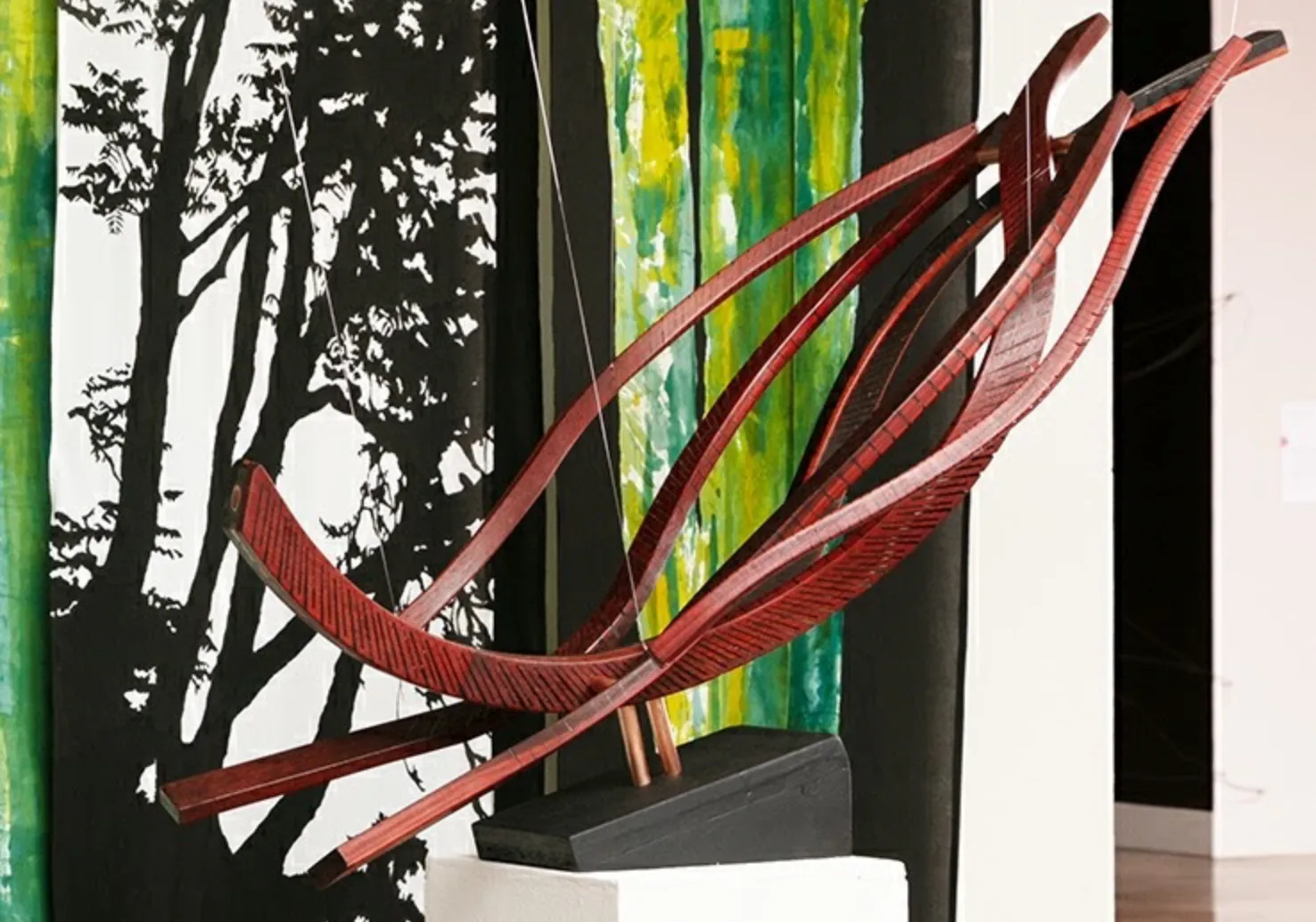
I am angry, and working in my studio quells that anger, twists it into shapes and forms, the likes of which people never expect. My work is abstract: it doesn’t contain literal narratives or reveal obvious rage. But it is relevant. I recognize that I do not have to change my voice in order to stay relevant. I need to stay true, as does every other artist who uses their voice at octaves most appropriate for them. I encourage any other artist who faces the same struggle: stay true to your voice and we will listen.

There’s a new podcast I just started listening to called Field Recordings. They describe their show as, “A podcast where audio-makers stand silently in fields (or things that could be broadly interpreted as fields).” And whatever you’re thinking that sounds like is probably close to correct. There’s no host, no editing; just the sound of a field, or a park, or ocean waves. The pieces range from one to fifteen minutes in length. Outside of the sounds of random people passing by, there’s no talking, so there’s no story, no emotional arc, no payoff at the end. Just the sound of tall grass in the breeze or ice skates on a pond or row boats passing under a bridge. They began releasing episodes right before the Covid-19 lockdowns started. And for me, during this time we’re living in, it’s a salve for my ears and thoughts. This kind of audio is not made for impatient listening. It’s not “content.” It falls into a category of what’s now called “slow radio.” And I’m all in.
This new show seems to go against what the heavy hitters in the podcasting world advise. I once read an interview with Ira Glass where he said that something interesting needs to happen in This American Life stories every ninety seconds. Ninety seconds! That is 40 actions per hour, so those waves in Field Recordings better be crashing or causing peril quite often. On the show 99% Invisible, Roman Mars breaks in with his beautiful, mellifluous, voice every couple of minutes to tell you what the story is about, where it’s been and where it’s going. Both of these examples are an expansion on the way NPR radio makers and related documentarians have been making stories for a long time. This format itself was designed for station identification and sponsor breaks. It does move along the story, but I’ve found this kind of storytelling doesn’t reward patience. It doesn’t reward close listening. I don’t mean to sound like I’m denigrating these shows. In fact, both of those creators have been my unspoken mentors through the years. Also, I’ve employed this very method in my own work. And these shows are clearly making vital, entertaining, and important work. What I am saying though is that they define the industry. If they created and followed these rules (they do), then so does everyone else. And that means that a larger variety of stories and a diversity of voices is not being heard.
Let’s return to the idea of slow radio. It’s a new term for an old practice. Essentially it means letting people tell a story and really listening. Across the pond in England, the BBC has been making these kinds of stories since… forever. It’s a little more rare here, as it’s not a commercially viable model. This kind of storytelling can be fun, interesting, informative, and sometimes even boring! For instance, I once heard a story of a tugboat captain out on his rounds. It was lovingly produced, sound rich and, on the surface, dry as dust. The radio producer spent the whole day, if not a couple of days, with the tugboat captain. Then they cut the tape together into a full half hour piece. The piece itself spends time with the sounds of the tugboat’s little engine as it drifts through the water or bumps up against a dock or another boat. You hear the cries of seagulls on the shore and the sound of ropes being thrown. You listen to a man with a strong Welsh accent telling you what it’s like to go about his day in a tugboat. There is no story arc, no emotional payoff, just an old man in a boat, towing other boats around, talking about his life and work. The beauty of it isn’t transcendent or heartbreaking. You have to slow yourself down to hear it. You have to adjust your expectations, quiet your mind and really listen. There’s another kind of listening at play here too. A kind of listening that invites one to go deeper into someone else’s lived experience. To find empathy for people you will never know. You do have to work for it a little bit though. You have to be curious and patient.
Like listening, curiosity takes time and is iterative. And, with both, you need patience. In my own work I try to focus on the intersection among these three concepts, deliberately removing myself from the narrative so people listening can absorb the content and meaning of the subject and narrative from their own viewpoint. I try to embrace the pauses between sentences, allowing someone to speak and think and speak some more without interruption. During interviews, I allow space between when people speak and when I ask follow up questions so I can easily remove my questions and let them delve into their own story.
Obviously many of you (well, most of you) are not as immersed in audio storytelling as I am, but, hopefully after this read, you will go check out some slow radio programs. I’ll throw some links in at the end of this. I believe there are ideas we can all take in around listening, like curiosity and patience in what we care about and create.
I was excited to be part of the latest Tilt West roundtable on Curiosity & Deceleration, and part of a discussion that speaks to my practice so well. Here are some things I’ve been ruminating on since:
Listen: I’ve heard others in my field saying they have to stop themselves from “editing” while others are talking. This is something I’ve struggled with a little myself. But I think that slowing down and really listening to others’ experiences and thoughts is a skill that has to be developed. The lockdowns have introduced this idea to me in a way, and I hope to keep working on this.
Be curious: Ask why. And don’t stop with the first why. Continuing to explore something through that simple question- or even reflection- allows an excavation of sorts that really gets to the heart of a problem. This also gets to the heart of a story. Your story and the story of someone who thinks differently than you.
Be patient: Let pauses happen. I know I have a tendency to want to fill empty spaces with noise but it’s not always necessary. Allow spaces to occur within your thoughts. I’m going to try to accept the idea of idleness, to allow for time and space to find inspiration.
Tilt West’s roundtable conversation centered on deceleration and explored the value of slowing down — something quarantines and closures have also fostered for many of us. Perhaps this cultural shift in perspective (even the experience of boredom) will foster a new appreciation for slow looking, slow listening, and slow radio.
Often the media is abuzz with how we are living at the moment of trans visibility and how, finally, trans rights are on the table. In many ways, this a false narrative because it erases the experiences of those on the margins of normative trans and gender non-conforming (gnc) identities. Here is where intersectionality plays a major role in our understanding of the logics of white-neoliberal-cisheteropatriarchy — through the stories and experiences of those who are left out of the imaginations of trans-ness.
Witnessing the discussion at Tilt West’s gathering on “Intersections & Transition,” I was left despairing about how trans and gnc discourses are often deployed within white and cis communities, which are not always mutually overlapping, to undermine the liberation visions that trans politics offers us. While race and colonialism were topics of conversation, their discussion was largely limited and limiting. In spite of Dr. Rushaan Kumar’s critical prompts and remarks in the discussion, the conversation mostly steered away from the lives of trans and gnc peoples of color and calling out structures of transphobia, colonialism, capitalism, and white supremacy that shape their lives. Although half of the participants identified as people of color and several as non-binary or trans, the conversation kept centering whiteness and cisness. The relative whiteness of the room speaks to these racial and colonial erasures. On these erasures, I offer five reflections.
Post-gender is not the same as post-race.
As much as trans politics is invested in undoing the binaries and labels, we fail collectively if we use a trans*analytic to argue against racial and ethnic labels. Race and gender do not function in similar ways. Non-binary and no-label gender politics points to the limits of binarism and cisnormativity, and demonstrates the need to go beyond the binary to account for the galaxy of gender identities and expressions. However, to impose this on race obfuscates the materialities of how race functions. Invoking trans politics to go beyond racial and ethnic labels is troubling. Post-gender is not same as post-race. In fact, post-race always already is racist. Thus, to use trans politics, specially by white and non-black peoples, to call for label-less futures is deeply rooted in racism and white supremacy.
Intersectionality is not obsessed with identities.
In the discussion, this post-gender/post-race analysis was being offered as a corrective to the assumed flaw of intersectionality, which is that intersectionality essentializes categories and identities. This (intentional) misinterpretation speaks to the privileges of whiteness. Black feminists and other feminists of color engage with intersectionality to tell us how identities are socially constructed, relational, contextual, and mutually co-constituted. To read intersectionality as being obsessed with racial and other identities, to me quite literally signifies that “I am white but I don’t want the world to question my privileges and positionality.” Intersectional critiques are not arguing for reifying identities, rather it’s the structures which produce these differential and oppressive lived experiences which maintain these identities and the differences. Going back to the previous point, to use trans politics as a way to critique intersectionality reeks of whiteness and colonial erasures.
Our notions of gender and sexuality are a product of colonialism.
Colonialism has to be central to the conversations on transphobia and cisnormativity. We can’t understand contemporary experiences of trans and gnc folks without understanding the last 500 years of colonialism. As much as race is a product of European colonialism, so are gender and sexuality. As feminist scholars of colonialism have demonstrated, cisheteropatriarchy and binarism were/are central to the project of colonial violences. European notions of gender and sexuality were not only imposed on colonized and racialized peoples, but were also used to deny their humanity. Decolonial feminist scholar María Lugones expands: “the gender system is not just hierarchical but racially differentiated and the racial differentiation denies humanity and thus gender to the colonized.”
Trans and gnc identities are not new; rather, colonial processes have worked to destroy these identities and expressions globally. This destruction worked in North America against colonized Indigenous peoples through genocidal logics that impacted Indigenous women, two-spirit and gnc peoples, as well as against African diasporic/Black peoples, as gender was obfuscated to justify their enslavement. In other parts of the world, transphobic laws like the Criminal Tribes Acts of 1871 in British India were imposed by European colonizers to criminalize gnc communities.
Attempts to characterize a common “transnational” experience are dangerously reductionist.
The global south or the “transnational” is often invoked in conversations on trans-ness in North America to say one of these two things: either that “we” have it so much better here in North America for trans peoples, or that trans peoples in other parts of the world, say Kathoeys in Thailand, Hijras in India, Fa’afafines in Samoa, Muxes in Mexico, etc, have so much more socio-cultural acceptance and recognition. Both logics create a false narrative of universal and homogenous trans identities.
First, things are not better for most trans and gnc folks of color in North America. From all the anti-trans bills and legislations across states in the US, to murders and killings of black and brown trans women, to everyday denial of basic humanity and rights, there are numerous testaments to the violence of transphobia. This form of trans-nationalism, drawing upon the analytics of homonationalism, reproduces the exceptionalism logics of North America as queer and trans friendly, without accounting for ongoing colonial, racial, and neoliberal processes in North America.
Second, to identify/label all gnc peoples in the global south as “trans” erases the local contexts, histories, and experiences of peoples. While, there are many people in the global south who identify as trans, there are many others whose identities can not to reduced to being trans. In many of these contexts, one’s gnc identity is not just an individual identity but rather a social, cultural, spiritual and communal identity and marker. North American/white definitions of trans-ness do not account for these complex identity formations and histories of colonialism (see the point above). To fold all identities into one universal marker of trans-ness, following the similar logics of “gay international” and “gay imperialism”, is trans international and trans imperialism.
There will be no trans liberation without decolonization.
Finally, within the North American context there is no trans liberation without the decolonization of Indigenous lands and abolition of all forms of anti-blackness. Without centering anti-racist and anti-colonial politics, trans rights are always going to be limited and only benefit a select (white) few. Writing as a non-binary queer person of color, this is how I envision any form of decolonial queer and trans liberation and futures. However, I am also writing as a dominant caste Hindu Indian diasporic person; and within the Indian and Indian diasporic contexts, gender and sexual struggles are incomplete without the annihilation of caste and caste structures. Thus, any one-dimensional struggle for queer and trans justice is limited if anti-racist, anti-casteist, anti-imperial, and decolonial analytics are not central to them.
Several years ago, I interned at a printmaking studio that had been hired to produce prints for a multidisciplinary artist who had recently received a MacArthur Fellowship, commonly known as the Genius Grant. On a hot afternoon, the artist wandered through the print shop in shorts and flip flops. The shop was buzzing with expert printers gathered around a hydraulic relief press they had decided to use to make the prints. The surface she wanted to print from presented unique challenges for the staff, and they all huddled together to troubleshoot how to do it without wrecking the equipment. Through trial and error, the staff had figured out a process, and after twenty minutes or so, the artist gave the green light and left. I pictured her heading off to the beach or wherever it is you can wear flip flops in the city. The prints came out beautifully. In smooth and dense ink, they recorded, directly, a viscerally felt phenomena that suggested other phenomena. They took forever to make, and they tested the limits of the equipment, but they were really wonderful. They were both magical and simple.
When some of these prints arrived at an art space in Denver a decade later, the gallery text contained no mention of the collaboration between the artist and the team who printed the work. As is the custom, their labor fell to the backdrop of support staff along with the frame shop, the moving vans, the museum staff, the writers, the viewers, the society, and the air they breathed.
In the world of fine art printmaking, the end result is a material object, typically a hand printed print, but the author only needs to have produced the concept (and not necessarily the object) to retain authorship. Others may contribute manual labor, but ultimately the work will be signed by an individual artist. A famous example is Alex Katz’s The Green Cap, 1985, which was produced in the laborious medium of Japanese wood block by Shi-un-do Print Shop. The practice of hiding the input of others and elevating the individual artist mirrors a power structure that seems to carry over from the society at large, roughly intact. Swirling around the taxonomy of artists and collaborators looms the quiet presence of copyright law with its mind-numbing attempts at quantifying creative contributions. Being almost entirely monetary in nature, it feels both heavy and meaningless as the words on your to-go cup, “Caution: Contents Hot,” which, reading through to the quiet part, gently reminds us, “If you sue us, we will countersue.”
Genius. It must flow through all of us in some moment, recalling the adage: “Do not miss your chance to blow/This opportunity comes once in a lifetime.” (Thanks, Eminem.)
Our English word “genius” comes partly from the root gene — “give birth, beget.” We hear in the word its connection to genes, which, at this point in history, we can easily hold in our imaginations as the largely unchanging program of our bodies. We are used to thinking about genius as innate talent, acquired at birth, our birthright. That can land in our conscience with the weight of inevitability and the sting of unequal distribution of talent as a resource. But the history of the word is slightly bigger. According to the Etymological Dictionary Online, the Latin “genius” was a “guardian deity or spirit which watches over each person from birth.” In other words, genius comes to us from a genie, “a ‘tutelary or moral spirit’ who guides and governs an individual through life.” A genie was thought to watch over EACH person — not just the rare birds, but the regular birds too. Through our genes and our genies, our talents are whispered into life. Winding back through the drift of its meaning, maybe genius started out as something more like a regular bird. No one ran for the bird books and binoculars when it landed on our trees. It was JUST A BIRD, who visited everyone, THROUGHOUT LIFE, not always the same bird, and not always the same visit. Genius might come from a place of cheerful negotiation between the nature and nurture of one’s gifts, as with Jonathan Van Ness, figure skating prodigy.
In a recent lecture at Colorado College, letterpress printer Amos Kennedy spoke about the peculiar relationship between monetary value and scarcity. Rare things like diamonds or gold, he pointed out, cost a lot, while things with dire intrinsic value often have no direct cost at all: air, water, dirt, love. Kennedy works, prolifically, in multiples, which sell for around $25 per print. His prints are alive with the ethos of social justice manifested through brightly colored conversational art and rhythmic overlapping of text, and they are bonded together with kindness, humor, history, playfulness. They resonate with people, and they sell. Under his rubric, his work is both relatively affordable and very valuable. One sense of a creative genius is someone who possesses a rare gift, a distinct individual who is freakishly good at something. There’s no harm in that, necessarily, but clearly there’s more to genius than scarcity.
Mierle Laderman Ukeles, an artist whose groundbreaking work included the public performance (as performance art) of manual labor in a museum setting, writes in her Maintenance Art Manifesto, 1969:
Now, I will simply do these maintenance everyday things, and flush them up to consciousness, exhibit them, as Art.
The Death Instinct: separation; individuality; Avant-Garde par excellence; to follow one’s own path to death — do your own thing; dynamic change.
The Life Instinct: unification; the eternal return; the perpetuation and MAINTENANCE of the species; survival systems and operations; equilibrium.
In bringing her ordinary life and the lives of others into public contemplation, Ukeles brought to the world an important concept: maintenance as a central part of life with the potential to be reframed and revalued as art. Her concept had cultural value. It has served as an important counterpoint to dematerialized conceptual art practices that were emerging at the time, and, perhaps most importantly, it highlighted the gulf between the traditional domestic sphere of women and the public sphere of the art world which, at the time, was almost exclusively male. Sixteen years after the Maintenance Art Manifesto, the Guerilla Girls embarked on their project of pointing out how few female artists were shown at prominent public art spaces.
And/but, there is a paradox here. Ukeles is a professional artist. She coined the phrase Maintenance Art. We are aware of her practice and her idea, partly because she attached her name to it and shaped a career around the boldness of her project. In furtherance of her career as an artist and not as something else, Ukeles produces and gets paid for her work. The same can be said for Amos Kennedy, who presumably also gets paid for his teaching and speaking engagements. If artists waived or redistributed their fees, only independently wealthy people could afford to dedicate their lives to making art, or to any type of institutional critique. Without the friction of the producer/consumer relationship, without recognizing and rewarding novel ideas, would such work be made at all? Does public recognition of creative genius create the conditions necessary for talent to emerge in the first place? What would killing the concept of genius honestly look like? Would we even want that?
If, for today, your genie made you very, very good at washing dishes, then maybe creative genius is about saying yes to that and valuing it. Wash your dishes. Do it right. In this case, genius could be thought of as something akin to “zeitgeist” or “spirit of the times.” This is the genius of setting out your sail to catch the wind. Although zeitgeist is not etymologically related to genius, the words are semantically similar. If creative genius is understood as something closer to the spirit of the times, maybe that points to a way to hold space for problematic geniuses like Michael Jackson or Louis C.K., talented people who have done things in their personal lives that we don’t like. That way, when our celebrities let us down, we can still experience their talent as something that comes from the culture and belongs to the culture, like Michael Jackson appropriating the moonwalk, as was mentioned at the Tilt West roundtable. Louis C. K. doesn’t own the laughter that resulted from the landing of his jokes. His audience doesn’t get a byline, but his jokes could not have worked without them. And maybe his audience would not have laughed, thereby completing the joke, if there hadn’t been a genie/zeitgeist working through him, warts and all.
Genius. Maybe fandom is as cruel as scapegoating.
Genius. Quit rocketing talented people to the stars where they become weird, and there’s no air for them to breathe, and they drift in space untethered to fact or consequence.
Genius. Quit moving the goal post and using your gatekeeper status to exclude the same people over and over.
Genius. But don’t talk yourself out of a career by being too pure.
Genius. Like, way to go, genius.
Genius. One could try to kill the concept, but not the fact that some people are really amazing at things, and we like to be amazed.
Genius. See how we dance around the quiet polarities of our words like greatness, amazement, talent, beauty, excellence.
Genius. It’s unfair and doesn’t exist, but still you know it when you see it, hear it, wrestle it to the ground, try to understand it, love and/or hate it, breathe it in, say it twenty times until it loses its meaning, then breathe it out all at once, and become it.
As a twenty-seven-year-old, thin white female from the United States who is close to finishing graduate school, I am expected to have a functioning, productive body and mind in order to be a “good” citizen in this capitalistic society. Especially in the public sphere, where my body and mind appear to function “normally,” it is assumed that I am able to move quickly, work long hours, and maybe even have an active social life a few nights per week. A career and a little fun are the expected goals.
I am an emerging artist and an arts writer. And I have invisible disability. I was diagnosed with cystic fibrosis at the age of six when my younger brother died of the same illness. Twenty-one years later, the amount of time spent on self-care and dependent-care just to move my body and mind is upwards of five hours a day. This time increases to twenty-four hours on those (not infrequent) occasions when I have to be hospitalized for two weeks at a time.
This essay expands on Tilt West’s roundtable discussion on disability, “Every/body: Art, Representation, and Accessibility,”elaborating on three concepts very crucial to the politics of disability: care, dependency, and crip time. These ideas have tremendously impacted my life but are rarely considered in disability studies and conversations.
These three terms speak not only to my personal experience with disability but to the various body and mind experiences of three important artists making headway in today’s contemporary art world. Carolyn Lazard, a Philadelphia-based artist, and Park McArthur and Constantina Zavitsanos, who work in New York, have begun exhibiting at such venues as the New Museum, the Whitney Museum, and the Modern Museum of Art. They have also won numerous awards for their artistic commentary on the medical industrial complex, debt, care, dependency, and crip time. While these artists mainly produce artworks, they also spend a significant part of their time writing and publishing about their personal experiences with disability, which is a crucial aspect of their practice as social activists working to expand society’s awareness of disability.
Care Collective (2011-present) is an ongoing performance project that comprises a network of people, including Zavitsanos and occasionally Lazard, who assist McArthur with her nightly routine, such as taking a bath, cooking dinner, and getting into pajamas. The collective makes evident both the significance of care and dependency and how care and dependency are rarely seen in public. Dependency is portrayed as unwilling reliance on another body, mind, institution, source of nutrition, medication, etc. It goes hand in hand with care because disabled bodies and minds often depend on continuous care from the self and others.
In “Sort of Like a Hug: Notes on Collectivity, Conviviality, and Care,” McArthur defines care as “a spectrum of dependency and labor different than childcare, different than elder care, and different than the heteropatriarchal configurations of an unwaged laborer reproducing a waged laborer for tomorrow’s workday.”[1] In other words, care is about caring for a body and mind that is not functioning, producing, or generating in terms of the capitalistic body and mind. However, as all these artists’ performances show, care and dependency do not exist within a system of binaries, but as part of a spectrum.
In their 2016 performance Support System: for Tina, Park, and Bob, Lazard exposes how care and dependency are interchanged not only between performer and participant, but between the person who is understood as receiving care and the person who is understood as giving care. From 9 a.m. to 9 p.m., during their residency at Room & Board in New York City, Lazard welcomed guests one at a time for thirty-minute intervals into their bedroom, a space dedicated to the private realm. Each guest was asked to either sit with Lazard, talk with them, or help them with chores.

According to Room & Board’s founder Julia Pelta Feldman, “part of the idea was to create a performance work that would allow [Lazard] to rest: a marathon of comfort instead of the extreme asceticism fetishized by the art world.”[2] This being said, however, Lazard ended up caring for their visitors by talking with them, conducting tarot readings, and providing them with emotional support. As one participant noted, it was a marathon of ‘affective labor,’ the kind that is least valued in our society, and that is (perhaps not coincidentally) most often performed by women.”[3] In the end, Lazard’s twelve-hour performance revealed how we are all dependent on one another and in need of care, whether we identify as disabled or not.
Support System, then, exposes how care and dependency are not experiences confined to people who identify as disabled. It shows how disability is not limited to one type of experience but actually a multitude of experiences tied to various complex embodiments. In other words, rather than revealing a simple binary of disabled and abled, i.e. Lazard and visitor, the artist explores how care and dependency (and in turn disability) are a spectrum: both Lazard and their visitor are within the spectrum because both are in need of care.
In addition, as Care Collective and McArthur’s nightly routine shows, McArthur is constantly dependent on her friends and loved ones to help her take a shower, get dressed, and get in bed. However, even though the artist receives care from and is dependent on her loved ones, partners, and friends who expect nothing in exchange, she still returns care to those who take care of her. In fact, a few months after Zavitsanos and McArthur began using letters, text messages, and text-based art to explore ideas of care and intimacy, McArthur began a routine of brushing Zavitsanos’ teeth.[4] Also, McArthur undoubtedly provides care to her friends and loved ones via emotional support, conversation, and company.

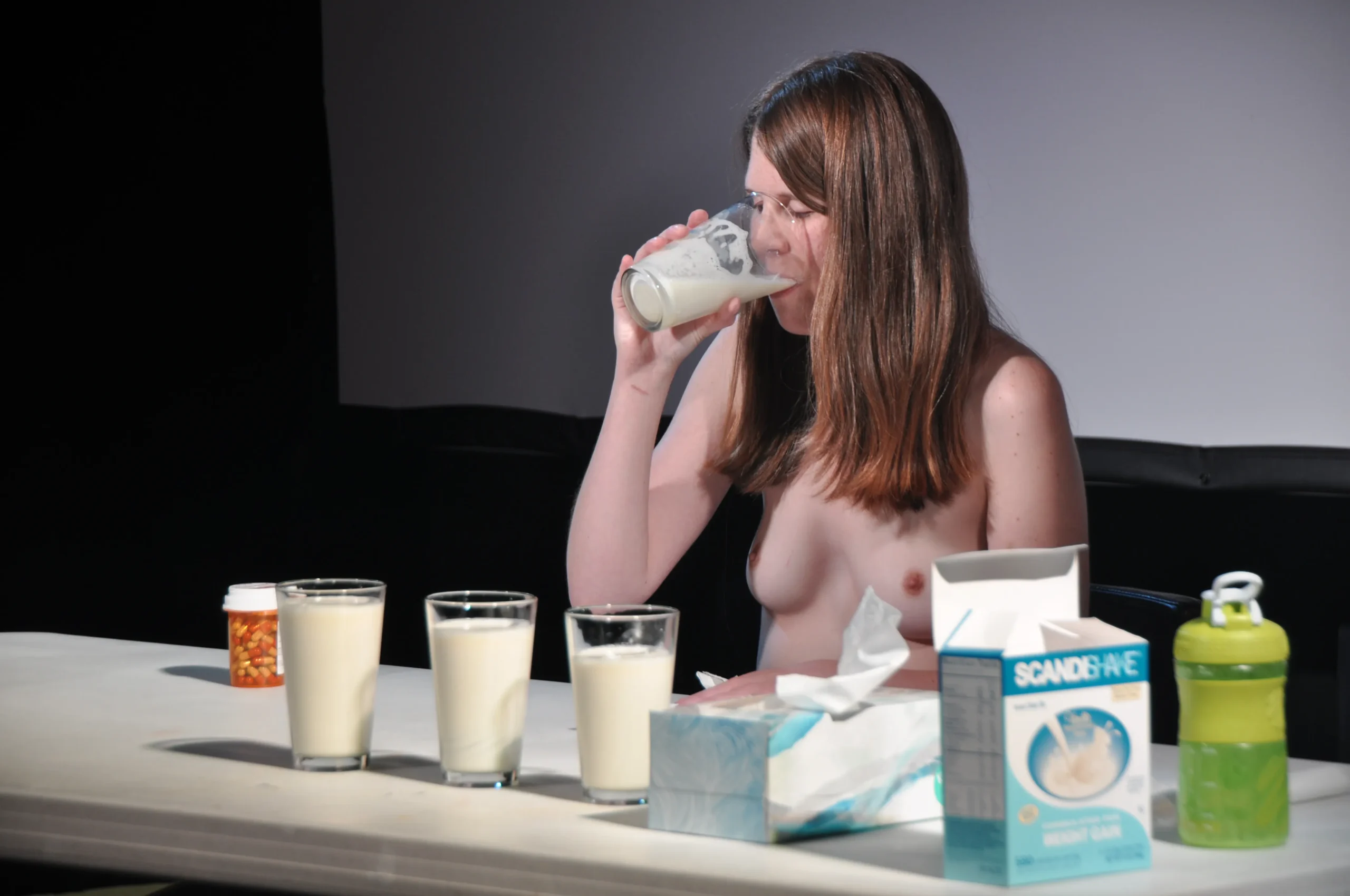
In my 2018 performance you need to gain weight to stay healthy, I wanted to reveal a type of care that causes pain but is needed in order to stay healthy long-term. On a mid-May day, I nervously handed out little tasters of weight gain shake to everyone sitting in the audience. I then waited for five minutes to pass and proceeded to take off my clothes down to my nude-colored underwear. I was shaking uncontrollably. Once I mixed the four weight gain powder packets with four glasses of milk, which added up to a total of three thousand calories, I drank all four glasses as my belly swelled with pain. Then I got up, started putting my clothes back on, and sat on the ground. As I was putting on my shoes, I quickly grabbed the nearest garbage can to puke what I had just imbibed.
This form of self-care via performance is an exhibition of dependency where I expose my dependence on weight gain shakes for “nutrition,” my dependence on doctors, my feeding tube scar, which itself displays my former dependence on a feeding tube, and the “nutrition” it provided me for three years.
Crip time, a term defined by Alison Kafer, is the temporality of non-normative embodiments, from the day-to-day negotiations of moving from one space to the other, to the long view of historical time that has historically written disabled people out of the future.[5] Namely, crip time is shaped by the experiences of disabled bodies and minds who remain largely invisible in political, social, economic, and historical spheres. While crip time can be experienced by all bodies and minds, disabled bodies and minds are hyperaware of crip time since they usually experience it on a daily basis, whereas others may only experience it during temporary bouts of illness, sickness, or disability.
Once I drank all four glasses of weight gain shake and started to put my clothes back on to show that we were now moving back into the public, the sphere where I do not look sick, where I have invisible disability, I grabbed for the nearest garbage can. While I did not plan this, it was the perfect moment to vomit because, since I threw up in what signified the public sphere, my movements and actions showed that I was still sick, always sick, no matter which sphere I was in, and demonstrated that crip time occurs in both spheres and thus blurs the boundaries between them. As a result, when the dividing lines between public and private are no longer there, issues of care and dependency are no longer an individual problem but a collective problem.
Ultimately, as determined by my personal experiences living in and through crip time and performing you need to gain weight to stay healthy (2018), I have come to understand crip time as my way of living. For me, crip time is when I do my breathing treatment at 7 a.m. and 10 p.m. Crip time is when I eat and take my oral medications. Crip time is when I take care of myself, when my partner takes care of me, when my mother takes care of me. Crip time is when I go to school or work and still have nausea and/or a headache. Crip time is when I rest and sleep. Crip time is when I feel well enough to ride my bike down to the park. Crip time is when I have to be hospitalized. Crip time, for me and my disabled body and mind, is all of the time. Crip time is embodied time.
Through our efforts of making the invisible visible, Lazard, Zavitsanos, McArthur, and I write and perform about our disabled bodies and minds to offer what scholar Sophie Anne Oliver explains as “an ontological and structural model through which the concept of embodied ethical spectatorship might begin to be imagined.”[6] Our work, sharing the experiences we live within our disabled bodies and minds and within the social constructions and institutions that choose to render disability invisible, along with the work by several other scholars and artists with disability, are only tiny steps toward a collective goal of changing the Western perspective that wants to write people with disability out of the past, present, and future.
Disability representation and accessibility in the arts are absolutely necessary to make the voices of the invisible shared, heard, and understood. However, it is crucial to remember and take notice of the components happening often times in the private sphere (i.e. personal experiences) of disability politics that must occur before entering the public sphere. Without acknowledging care, dependency, and crip time, it is almost impossible to completely address issues surrounding disability representation and accessibility in the arts.
I lived in South Africa and worked there as a journalist from 1993 to 1996. I had the privilege of covering that country’s first all-race ballot in 1994. In 1995, while visiting the United States for the first time in two years, I found that many relatives and friends were curious about the historic, apartheid-ending election. A cousin had a question on which I still think back often. Particularly these days.
My cousin wanted to know: “How do black South Africans vote? On what do they base their decisions?”
Black South Africans had been denied citizenship and cheated out of education for generations. I suppose my cousin’s question was fair. But I bristled. I’d heard too many dismissive suggestions from white South Africans that their black countrymen and women “weren’t ready for democracy.” White South Africans, whose prejudices and privileges had been fed and coddled for generations, had much to prove when it came to readiness for democracy, but no one was giving them a poll test.
History tells us no one is ready for democracy. Not the American colonialists who believed so little in their own declarations of the equality — on which democracy depends — that they held slaves and denied the vote to women and the landless. Not the descendants of those slaves who marched and died demanding to be enfranchised. Not the East Germans whose wall fell in 1991 — few questioned their readiness to vote despite the fact that dictatorship and suspicion were all many knew, and I suspect that was because they were white.
White or black. European, American, African or African-American, democracy isn’t given to you when you’re ready. You take it when you can, then you make it work.
On what do we base our votes? Sure, sometimes on a sober assessment of the facts, a determination of what is true. Sometimes on fear. Sometimes because we believe it’s good for our tribe, whether that’s our neighbors in Crown Heights or our fellow Xhosa.
As I mentioned, I’ve been thinking about my cousin’s question a lot lately. Americans readied for democracy by more than two centuries of trying it out have proven as likely as any rank novices to make their decisions based on impulse, insularity or ignorance.
But we do get to keep trying. We make mistakes, correct, repeat. And repeat. Democracy is not an end. It’s the best means we have of working out our differences. Then we encounter new differences and return to the work of perfecting our union. We’ve been doing it so long in America we have perhaps forgotten what the alternative to democracy — to continually making democracy — will cost us.
I sense a lot of the angst we’re feeling now over the state of our democracy and its susceptibility to untruths does not come out of an actual inability to determine the facts.
People say figuring out what’s true is difficult. Often, what they mean is that they’re finding it difficult to let go of what they want to believe, or finding it uncomfortable to consider how their cherished lies affect others.
Yes, we have to contend with misinformation. But we are capable of recognizing the lies. It’s just that we sometimes don’t want to. We sometimes would rather undermine democracy than face the truth.
Luckily, we have art — fiction — to help us. To inspire us when our energies and commitment lag. Our truest myths endure because they order the facts into stories that can sustain us and help us remember where we set out to go.
Perhaps democracy is the fiction we need the most. It demands faith in cooperation and selflessness — without which a diverse society won’t long endure.
Masturbation Painting, Fuck Grid, Cunt Painting…
When I was asked to write a companion piece to Tilt West’s roundtable discussion on The Problematic Nude,[1] prompted by artist Laura Shill [2], these titles and the associated works by Betty Tompkins [3] first came to mind.

Tompkins started making these photorealist paintings and drawings between 1969–1974 and came under immediate fire from many feminists for making such frank work about pleasure.

On first view, Masturbation Painting #2, Cunt Painting #12, Fuck Grid #34 are close-ups of a woman touching herself, a woman’s cunt, and heterosexual penetration — images similar to what is typically seen in porn magazines and videos.

But, here, under Tompkins rendering, they are hushed, soft, and calm. Using heightened cropping, the artist slightly abstracts her subjects; the woman’s labia is organically florid or softened to peach-like skin. The effect is different from a photo in a men’s magazine. The images center a woman’s pleasure.
At the beginning of the roundtable, Laura Shill posed questions about the role of the nude, describing “female bodies as political battlegrounds where fights over agency, autonomy, and access are waged both publicly and privately.” More specifically, Shill alluded to the “disproportionate…. (privilege given to)…. images of nude women made by men.” Shill invited us to consider focusing our attention on women as subjects and authors, yet the conversation soon returned to the male gaze and centered on the problems that arise therein.
I’ve been struggling to write this article. I’d prefer to talk about female desire, which has only recently been acknowledged. Gasp! Women experience, need, and desire sexual pleasure. Not just whores — ALL (or most) WOMEN. Sexuality is complex and doesn’t fit into a neat either/or.
There are so many things I have to say — both from experience and years of research. Having personally dealt with sexual objectification, political and economic inequality, and domestic and sexual/violence, I am convinced that the traditional female nude — a cis white male visualization of female sexuality — plays a huge part in cementing inequality. There is a daily onslaught of media portraying women as flat objects with very little to no agency, or as fragile beings who are incapable of making their own informed decisions.
That being said, there is nothing inherently wrong with a man’s desire to look at a woman; rather, the problem arises in how this look is played out to reinforce the objectification and subjugation of others. These images are fabricated to serve a specific need. There is no denying that many of us use images to enhance pleasure. I enjoy porn, looking at both women and men. The female nude is not the problem; the problem lies in the dynamic portrayed in the images — between power and powerlessness — and the privileging of one gaze and one type of pleasure over another.
Even though I understand that this is an important component to the conversation, I don’t want to talk about the male gaze anymore. I’m tired of this old binary, this conversation that centers the cis white male experience and excludes LGBTQIA+ narratives and “othered” stories. If you’re involved in making (or buying) images that portray women as flat sexual objects, or simplified one-note narratives like the dangerous vamp, dumb blonde, exotic dancer, childlike waif, girl next door, harpy wife, mammy, sexless mother, or sexy secretary, don’t be mad or petulant when I don’t give a shit about your work. I would never argue for censorship. But there’s nothing new in it. Boring.
Simplified one-note narratives are not fully lies; I think of them as lies of omission.
The problem of the female nude rests in the lies it tells: of denying female desire and complexity. Women are reduced — in stature, earning power, relationships — by this falsity.
Here we are. Each of us is culpable and responsible for talking about and formulating strategies both as creatives and consumers that challenge inequality. We can band together with allies, work to gain understanding about intersectional feminism, and break structures that hold us down from earning an equitable living — or be subjected to violence in our lives.
Laura Shill”s quote by Hélène Cixous [4]from, The Laugh of the Medusa, seems a fitting end note:
The future must no longer be determined by the past. I do not deny that the effects of the past are still with us. But I refuse to strengthen them by repeating them, to confer upon them an irremovability the equivalent of destiny, to confuse the biological and the cultural. Anticipation is imperative.